.

Thursday, September 18, 2008

USFS cuts fine for congressman involved in escaped fire

Wildfire Today first covered this on June 4, but now there are new developments.

From The State.com
By JAMES ROSEN - jrosen@mcclatchydc.com


WASHINGTON — A senior federal official, fearful of incurring a congressman’s wrath, sent subordinates on a mad dash earlier this year to retrieve a certified letter demanding payment of $5,773 for starting a fire that burned 20 acres of a national forest.

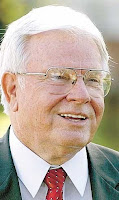
U.S. Rep. Henry Brown, R-SC

Mark Rey, undersecretary of agriculture for natural resources, said he didn’t want U.S. Rep. Henry Brown to receive the March 12 letter before he testified before a U.S. House committee on which the South Carolina Republican sits.

“I’d just as soon have him not take a chunk of hide out of me,” Rey said Wednesday.

Rey confirmed the actions of Forest Service collections agents as outlined in internal agency documents McClatchy (newspapers) obtained.

Mark Rey, Undersecretary of Agriculture for Natural Resources

The disclosures flesh out Brown’s four-year protest of a criminal citation and civil damages collection for a controlled burn he started March 4, 2004, on his Berkeley County property that spread to the adjoining Francis Marion National Forest.

Rey defended his decision to intercept the letter as “a reasonable precaution” to prevent Brown from “stewing on it while he’s sitting up there on the dais” of the U.S. House Natural Resources subcommittee, which oversees management of national parks and forests.

As a result of Brown’s case, the Forest Service in June rewrote a criminal code to make it more difficult to prosecute people who negligently set fires on federal land — about 80 fires a year in the South alone.

“It will be much harder for us to go after people who allow fires to escape from their property onto the national forests,” said Jack Gregory, who was the Forest Service’s top law enforcement agent in the 13 Southern states at the time of Brown’s 2004 fire.

A separate law governs arsonists who intentionally start fires in national forests.

Public land wardens and private property owners do controlled burns to remove underbrush, dead trees and other tinder that makes forests more vulnerable to fires.

Rey, a former timber lobbyist and a political appointee of President Bush, is responsible for running 156 national forests and 34 other federal lands on 191 million acres in 44 states.

AN ISSUE OF FAIRNESS?

Brown paid a reduced fine of $4,747 in April, but only after ensnaring dozens of federal employees in a conflict that cost the government an estimated $100,000 to resolve.

Forest Service officials agreed to remove accrued interest and late-payment penalties, reducing Brown’s bill by more than $1,000.

The Brown saga shows the power of a single congressman, especially one going up against an agency over which he has oversight responsibility.

“This is ticket-fixing at the highest levels,” said Jeff Ruch, executive director of Public Employees for Environmental Responsibility, a Washington legal group that defends government whistleblowers. The group filed a Freedom of Information Act request that produced the Forest Service documents related to the Brown case.

Brown believes he was treated more harshly than others to set an example.

“I was so taken aback that I’d be treated so impersonal — like I was some kind of crook,” Brown said Wednesday. “Those were criminal charges that were filed against me. I felt like I was the victim.”

Brown said many people who start fires on public lands face no charges.

“I know for a fact that on Highway 17 (in South Carolina), there was a lady burning trash and the fire got away. It burned several thousand acres of national forest, but she didn’t pay a fine.,” he said.

Brown added, “Because I’m a congressman, you don’t have any sympathy for me, but you could have sympathy for the little old lady that set a trash fire.”

After Brown was cited for negligence in a federal misdemeanor charge, he hired a lawyer and billed the federal government $9,040 for alleged damage to his land from a controlled burn he said Forest Service rangers set in 1989 — 15 years earlier.

Government lawyers rejected the claim, saying it had exceeded the federal statute of limitations.

Brown then went on a personal crusade in which he complained about his penalty in numerous e-mails, letters and phone exchanges with U.S. Forest Service employees in Washington, South Carolina, New Mexico and elsewhere.

Rey said he met with Brown “at least two times” after the congressman summoned him to his Capitol Hill office to discuss the dispute.

Gregory, the former top Forest Service law enforcement agent in the South who retired in December 2006, said he notified Strom Thurmond Jr., the U.S. attorney for South Carolina, of the pending charge against the congressman in March 2004.

“Whenever we encountered people who were important political types, we had to go to the U.S. attorney’s office before we entered a criminal case,” Gregory said. “I did that (with Brown). They said go ahead and charge the congressman criminally.”

Gregory and John “Andy” Sadler, based in the U.S. Forest Service’s Columbia office as a patrol captain in the agency’s uniformed agent corps, said Brown and a helper used buckets and trash cans filled with water to try to contain the controlled burn.

“Congressman Brown didn’t intend to burn National Forest land, but he was careless and lazy that day,” Gregory said.

FIGHTING BACK

Brown didn’t take the charge lying down.

Sadler said Brown spoke by phone with him and Jerome Thomas, supervisor of the Francis Marion and Sumter National Forests.

During the March 26, 2004, phone conversation, Brown made “an implied threat” of increased congressional scrutiny of U.S. Forest Service programs if the criminal charge and fines against him were pursued, Sadler said.

Rey, though, said Sadler and Thomas might have misunderstood Brown.

“Some of our folks assume when they’re dealing with an angry member of Congress that repercussions will follow,” Rey said.

Sadler and Gregory filed a federal whistleblowers complaint that accused Brown, Rey and other Forest Service employees of obstruction of justice, extortion and other crimes.

A review by the Inspector General’s Office in the Agriculture Department, the Forest Service’s parent agency, did not find sufficient evidence to support the allegations.

Rey said he oversaw the recent stiffening of the criminal negligence code for fires that spread to national forests after Brown’s case helped him realize there was a double standard.

The Forest Service, Rey said, had never admitted criminal liability in any controlled burns its rangers set that spread to private property.

“I just didn’t feel it was equitable for us to be holding private landowners to a standard that we were unwilling to be held to,” Rey said.

Whatever the explanation, Sadler said, fewer people will be held to account for starting fires in the national forests.

“As a result of all this stuff, the agency’s pretty well changed its prohibitions on what is actually a crime anymore,” he said. “It’s kind of within their authority to do that, it just doesn’t look too swift.”

Rosen covers Washington for McClatchy newspapers in South Carolina.
Wednesday, September 17, 2008

Wildfire news, September 17

Firefighter injured while falling a snag

On September 10 a firefighter from the Entiat Hot Shots was injured while falling a snag on the Rattle fire near Toketee Falls, Oregon.  

From NRtoday.com, Sept. 16:
Pilar Castro, a Wenatchee, Wash., firefighter said to be in his mid-20s, suffered a fractured skull and broken ribs when the top of a dead tree broke off and struck him Wednesday, said Robin DeMario, spokeswoman for the Okanogan-Wenatchee
 National Forest.

Castro, a member of a hot shot crew, had to have surgery on his skull and part of his jaw reconstructed. He was flown by helicopter to Mercy Medical Center in Roseburg.
The firefighter remained there in fair condition this morning, a hospital spokeswoman said. DeMario said Castro is expected to fly today to a hospital in Wenatchee, where he will undergo rehabilitation for about a month.

From Inciweb, Sept. 13:
Last Wednesday evening, a firefighter was injured while cutting a dead tree with a chain saw along the fire line. He was injured near his cheek and bruised his ribs. After being airlifted to the hospital in Roseburg, he was treated for his injuries and is recuperating. On Sunday, he will be flown home to Washington State where he is expected to make a full recovery. It was very fortunate that his accident occurred near an established helicopter landing site where he could be air lifted for immediate medical treatment.
Thanks for the tip, LR

Oregon:  Rattle fire spots 2 miles ahead

Rocks and logs on Highway 138, Sept. 10, 2008

The fire on which the firefighter was injured while falling a snag last week has been very active.
Idleyld Park, OR --- Yesterday's severe fire weather conditions contributed to some very extreme fire behavior. A plume of smoke rose to over 35,000 feet and carried fire brands up to 2 miles from the head of the fire. The fire grew an estimated 4,183 acres and now totals 11,207 acres, most of which remains within the boundary of the Boulder Creek Wilderness. 
Photo and text from InciWeb

San Diego County contracts for Superscoopers


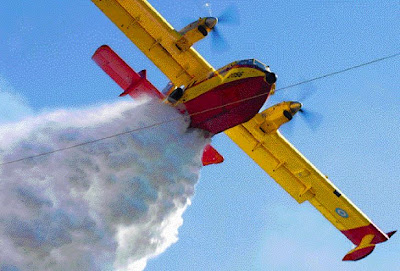
San Diego County is gradually taking steps to increase their fire preparedness after being criticized in reports following their massive fires of 2003 and 2007.  The City of San Diego recently purchased their second helicopter, and the County is contracting for two Bombardier CL-415 Superscooper air tankers and a lead plane for three months.  

HERE is a link to a page with a video from San Diego 6 that shows a demonstration of the aircraft in action Tuesday.  

Contract firefighter dies following road grader accident
A 77-year-old Happy Camp man has died from injuries suffered while serving as a contract firefighter in Siskiyou County, a U.S. Forest Service spokesman said Tuesday.

Gov. Arnold Schwarzenegger on Tuesday commended Curtis Hillman Sr. for his service and announced that Capitol flags will be flown at half-staff in his honor, a spokesman from his office said.

Hillman, a member of the Karuk tribe, was operating a grader to improve road conditions and access for firefighters. They were working the Siskiyou and Blue 2 Complex of fires when Hillman was injured Aug. 25, public information officer Mike Ferris said.

He was working on forest roads 14 and 21, about half a mile from Highway 96 just south of Dillon Creek Campground, Ferris said. The area is halfway between Happy Camp and Orleans.

When his grader failed to start, Hillman and another worker tried to fix the problem. The grader then started, but its brake failed and it began to roll backward. Both men fell or jumped off the machine, and Hillman hit his head, Ferris said.

He was flown to Mercy Medical Center in Redding, where he died from his injuries Thursday, Ferris said.

His is the 13th death as a result of the June lightning strikes that ignited fires across the north state.

A celebration of Hillman's life is scheduled for 2 p.m. Saturday at the River Park Pavilion in Happy Camp, Ferris said.


Tuesday, September 16, 2008

Tanker 09's last drop

Here is a photo of Tanker 09's last drop before they went back to Reno to refill and then crashed on take off September 1.

Photo by Robert Mesa of Santa Clara, California.

Wildfire News, September 16

Satellite Phone Surge

Satellite telephones are no longer rare in emergency management. Here is an excerpt of an article from Forbes.com:
Greg Ewert lives in Maryland, but Hurricane Ike has been keeping him up at night.

As executive vice president of global channel distribution for Iridium Satellite, Ewert aims to make sure that organizations ranging from the Red Cross to the Federal Emergency Management Agency (FEMA) have ready access to his firm's satellite phones.

The job has been getting tougher. Hurricanes Gustav and Ike have swelled demand, prompting Iridium to ship 6,200 phones over the past three weeks. Last week, as Ike bore down on the Texas coastline, the firm's call traffic in the region tripled. Two weeks ago, when Gustav swiped New Orleans, the company's Louisiana traffic doubled.

"Three different areas in the southern U.S. have been affected in the last 30 days," says Ewert. "We're calling into service more equipment than we have in past years."

So far, Iridium has managed to meet demand. The company's policy of keeping three months' inventory of phones prepared it for the recent run on handsets. It has been routing calls the way it normally does: through its network of 66 satellites and down through a "gateway" station in high-and-dry Tempe, Ariz. This sky infrastructure insulates Iridium's system from whatever is happening on the ground, be it a hurricane, earthquake, wildfire or civil uprising.

The hurricanes, grim as they are, highlight Iridium's recent achievements. Its frothy rise under Motorola (nyse: MOT - news - people ) and subsequent $5 billion bankruptcy in the late 1990s led many to write it off as a costly flop. New management and foreign investors resuscitated the company in 2000 as Iridium Satellite.

Iridium's goals have since come down to earth. It has 305,000 subscribers--much fewer than the 1 million it once pursued but enough to make it the world's fastest-growing mobile satellite services provider. Frost & Sullivan has declared Iridium's service more reliable than that of its closest competitor, Milpitas, Calif.-based Globalstar (nasdaq: GSAT - news - people ), for the past two years.
Cellphones used for emergencies

And speaking of emergency communication, Forbes has another article about the usefulness of cell phones to provide important information during emergencies. Here are some excerpts:
The Federal Communications Commission is developing a national mobile alert system for 2010. The messages, which will be distributed through the country's four largest carriers AT&T, Verizon, Sprint Nextel and T-Mobile will include "presidential" or national emergency alerts, weather and local emergency alerts and child abductions. In a statement, FCC commissioner Michael J. Copps praised the ability of mobile alerts to reach people who aren't near a TV set or radio or lack electricity.

The move follows the FCC's attempt to establish a public safety communications network on radio spectrum auctioned earlier this year. Such a network would enable police and emergency workers across the country to seamlessly communicate on wireless devices. The FCC has said it hopes to establish such a network within the next few years.
and...........
Mobile alerts--messages moving the other direction--are another way cellphones can save lives. Manhattan-based Send Word Now delivers millions of mobile alerts a year for corporate, academic and public sector clients including Wal-Mart, Boston University and the U.S. Postal Service. New York City is testing a Send Word Now program that combines emergency notifications with everyday warnings, such as traffic. Text alerts have been growing in popularity for the past two years, says chief executive officer Tony Schmitz. Reliability and speed are factors. Even when phone lines and cellular networks are clogged with traffic, text messages tend to get delivered, within minutes.

......Advocates say that mobile safety functions are getting smarter and more specific. Send Word Now can program messages to be distributed automatically as soon as its software detects an event or disaster, speeding up the process and removing human error. Some firms are attaching documents to text messages--perhaps a floor plan for evacuation or a list of emergency procedures for employees to follow.
Yellowstone conference

Even the Associated Press has picked up on the conference which begins on September 22 in Jackson Hole, Wyoming.
YELLOWSTONE NATIONAL PARK, Wyo. (AP) An international "Who's Who" of wildland fire management and science is set to gather in Jackson, Wyo., later this month to look back at the 1988 fires in Yellowstone National Park and the northern Rockies.

"The '88 Fires: Yellowstone and Beyond" is the subject of the park's Ninth Biennial Scientific Conference, to be held in Jackson from September 22 to 27.

Featured speakers include Norm Christensen, professor of ecology and founding dean of the Nicholas School at Duke University; Tom Zimmerman of the U.S. Forest Service Rocky Mountain Research Station; Cathy Whitlock of Montana State University; retired Yellowstone Superintendent Bob Barbee; Steve Frye of the Montana Department of Natural Resources and Conservation; and John Varley, executive Director of the Big Sky Institute at Montana State University.

Rescued bear update

CBS13 has an update on the bear cub that was rescued after being burned on a fire in northern
California.
Li'l Smokey," a black bear cub rescued by a firefighter while fleeing a Northern California wildfire, has taken a major step in his recovery.

The bear cub is now walking on bare paws! Doctors have decided to give Lil' Smokey a trial at walking around without bandages or booties on his burned paws. Workers at the Lake Tahoe Wildlife Care center say his paws are a bit red but that's to be expected.

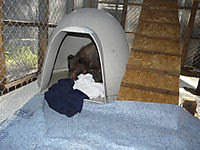
Smokey has also been moved to a new bigger cage with one screened side that means
he will be subjected to the natural weather outside. He also has a small igloo so he can "cozy down". Workers say he's already moved all his favorite toys and blankets inside the igloo.

Lil' Smokey now weighs 35.2 pounds meaning he's gained almost 25 pounds in the 8 and a half weeks at the center.

Doctors are also more optimistic that Smokey will actually be released back into the wild.

The cub, rescued by firefighter Adam Deem from a the "Moon Fire" near Redding on Thursday, July 17, likely stepped on scorching ground, and may have been burned by the flames.
Check out Smokey's blog.

NPR Series on fire in Yellowstone

National Public Radio's "Weekend Edition" is doing a series of five reports on fire in Yellowstone National Park called "Evolution of a National Treasure". Each one has a fairly short written version available on the Internet and also a 3 to 9 minute audio version. Four episodes are available so far:


Russians suspected in Georgia fire

Wildfire Today covered a similar incident on August 25, and it has apparently happened again. From UPI:
TSAGVERI, Georgia, Sept. 16 (UPI) -- Georgia says it has formed a commission to investigate whether Russian soldiers purposely started a forest fire in a popular national park.

Some witnesses near the Borjomi-Kharagauli National Park said they saw a
helicopter in the area on Aug. 15, only hours before Russia and Georgia signed a cease-fire halting the military conflict. Some said they saw "burning things" being dropped from the chopper onto the park, The Washington Post reported Tuesday.

The Georgian government commission says it will investigate if Russia deliberately started the forest fire, which has burned 2,500 acres of old-growth forest and crippled a major tourist attraction.

"I believe that yes, (the Russians) did it," said Revaz Enukidze, an official with Georgia's Environment Ministry, adding he thought the fire was started "to make as much as possible the economic and moral damage before the cease-fire."

"They know that this place is the treasure of the country," Natia Muladze of the park's visitor services told the Post. "Borjomi was full of Russians during the Soviet times, and they wanted to destroy the things which they could not take."
California: fire caused by marijuana farmers

I don't understand why fires caused by pot growers are so common. If you're doing something illegal, why start a fire that brings attention to what you're doing, shuts down your operation, and may lead to your arrest? But pot growers on public land are usually not the sharpest tools in the shed to start with. And, they are probably using "disposable" workers that are in the country illegally.

From CBS47.tv:
Madera County Sheriff's investigators say the wildfire burning near North Fork was caused by a sophisticated marijuana growing operation.

Investigators working on the Cascadel Fire discovered about 6,000 plants in multiple plots in the area. They also found a number of dead fish they suspect died from chemicals from the pot farm leaching into the pools.

Narcotic agents removed two pounds of processed marijuana and a total of 5,918 budding plants, with a combined street value worth nearly 18 million dollars.

The fire is now 70% contained and has already scorched 280 acres. Helicopters are still being used to drop water on hot spots but crews expect the blaze to be contained sometime on Tuesday.

Monday, September 15, 2008

Cancer among Seattle firefighters

Wildfire Today has covered cancer among firefighters previously, but more information continues to be available about this risk.  Here is an excerpt from an article in the Seattle PI:
Cancer takes heavy toll on Seattle firefighters
City defends itself against charge it could do more

By KATHY MULADY AND CASEY MCNERTHNEY
P-I REPORTERS

Dave Jacobs started fighting fires when he was 20. It was the only job he ever
 wanted. He battled brush fires in California, house fires in Oregon and fires of every kind in more than two decades with the Seattle Fire Department.

Now 57, Jacobs is fighting cancer.

A year ago he was diagnosed with esophageal cancer. There are days when he can barely swallow a few spoons of soup. The disease has progressed to his liver and lymph system.

Cancer is a presumptive disease in firefighters -- more than a third of Seattle firefighters hired before 1977 have developed some form of the illness. Under Washington law, seven forms of cancer are assumed to be job related when they are diagnosed in a firefighter.

But there are many other cancers that aren't on the list, forcing men such as Jacobs to prove that their illnesses were job related to get workers' compensation. Seattle firefighters say the city is not doing enough to help screen them for cancers and other health risks. City officials are sympathetic but question the effectiveness and cost of health screenings.

"My heart goes out to the other firefighters who have yet to be diagnosed," Jacobs said. "This job is a killer."

According to the International Association of Firefighters, more union firefighters died of cancer in 2007 than from heart attacks or fire-related injuries combined. Nationally, there were 38 union firefighters who died last year from cancer, 16 from heart attacks and 10 from fire-related causes. That trend is continuing in 2008.

It is assumed that if a Washington firefighter who was on the job for 10 years develops prostate cancer before age 50, or brain cancer, bladder or kidney cancer, malignant melanoma or several others, it was in the line of duty.

In this state, three of five active firefighters who died this year were cancer victims. The other two died fighting California wildfires.

Seattle Battalion Chief James Scragg -- a survivor of the deadly Pang warehouse fire -- died of lung cancer Jan. 17 at age 54. Seattle firefighter Tim Heelan, 43, also died in January after melanoma spread to his lungs and spine.

Marty Hauer, a Kent firefighter who traveled the nation teaching fitness seminars to other firefighters, stunned colleagues when he revealed that he had thymic carcinoma, a rare thymus gland cancer. He died in June at 41. Dozens of others are fighting the disease.

Of 975 firefighters hired in Seattle before 1977, about 350 have been diagnosed with cancer, and 43 of the men were younger than 60 when diagnosed, according to numbers from the Seattle Firefighters Pension Board.

Wildfire news, September 15

Terry Barton's trial nearing conclusion

The testimony phase of the trial has ended and attorneys from both sides will present summaries of the facts by September 22.  The judge will make a ruling on the case sometime after that. There is no jury.   

From the Denver Post:
A federal judge is set to decide whether the government should pay for the negligence of Terry Barton, a former U.S. Forest Service employee (Fire Prevention Technician) who caused the largest wildfire in Colorado history.

Lawyers for several insurance companies that covered the losses from the 2002 Hayman fire have sued the federal government asking for more than $7 million in damages. Their lawsuit alleges that Barton was negligent in her duties as an employee while working for the government and that the United States should pay for what happened.

The Hayman fire started on June 15, 2002 after Barton burned a letter from her ex-husband, John Barton, in a campfire ring while the Pike National Forest was under a fire ban.

Barton, who has served six years in prison, testified in the case on Friday during the bench trial held in Judge Wiley Y. Daniel's courtroom. She said that when she burned the letter, which she described as a reconciliation attempt written by her ex-husband, she was distraught and wanted to end her marriage.

"It was just a symbolic gesture," she said. "I wanted to go on with my life."

She also testified that when she walked away from the campfire and got into her truck, she thought the letter was extinguished. It was not until she was driving away, and returned to seek a faster route out that she saw the flames were approaching the trees.

At times tearful, Barton said she thought she used a shovel to move dirt to suppress the fire, but she could not remember the details of how she tried to stop the blaze. She also testified that she would have never walked away after she burned the letter had she seen it was still aflame.

Daniel did not say how he would rule in the case, but he hinted he was having a hard time deciding whether her actions that day were within the scope of her employment, which would make the government liable.

Mike Roach, who represented State Farm Fire & Casualty Company, Inc., argued that Barton, who had trained as a wildland firefighter, did not make a direct attack on the fire, which caused it to spread out of control.
"She had time to fight the fire before it got into the trees," he said. "She did not perform a direct attack. A direct attack is much faster."

Assistant U.S. Attorney William Pharo argued that the insurance companies did not prove that she was acting within the scope of her employment when she tried to put out the fire or if the way she tried to put it out was the wrong way.

"There is no evidence had she done something different that this fire would not have spread," Pharo said.

Tree felling + propane tank + power line + house = fire

Many of us have had things go wrong while felling trees.  This person had a particularly bad day.

From The Latest
John Woodland, Chief, Superior FD, Montana

A property owner in Superior set out Sunday afternoon to remove several trees from his rental property. He dropped the first tree without too much trouble but things went down hill from there. 

The second tree fell about 90 degrees from its intended path, hitting the dome covering the valve and regulator on a just filled 500 gallon propone tank and causing a gas leak. 

All that was needed now was a source of ignition, readily supplied by the overhead electric service line that the tree also took out. Completing the picture was the manufactured home 15 feet away, now more prone to ignition as a result of the broken window and exposed structural members in the roof where the upper portion of the tree landed. 

When the Superior Volunteer Fire Department arrived, the propane tank and pine tree were burning vigorously and blinds in the house were melting. Superior cooled the house before any ignition occurred and focused on keeping the tank from getting too hot until the contents burned off. 1,000 feet of 5 inch hose was laid to a hydrant. 

Marijuana grown in National Forests and Parks

The USA Today has a story that says 75-80% of pot being grown outdoors is on state or federal land.  
Tighter border controls make it harder to smuggle marijuana into the USA, so more Mexican drug networks are growing crops here, Walters says.

"We are finding more marijuana gardens in the park year after year," says Jim Milestone, superintendent of Whiskeytown National Recreation Area in Northern California.

"We're dealing with some bad characters," Milestone says. "We are arresting people … who have criminal records in Mexico, and almost all of them are here illegally with false papers."

The number of marijuana plants confiscated on public land in California grew from 40% to 75% of total seizures between 2001-2007, says the state's Campaign Against Marijuana Planting task force.

Hunting and cleaning up after pot growers diverts resources at a time when parks face chronic funding shortfalls, says Laine Hendricks of the non-profit National Parks Conservation Association.

Recent busts:

•A site with 16,742 marijuana plants was raided last month in North Cascades National Park in Washington state. It was operated by a Mexican organization, says park Superintendent Chip Jenkins. People living at the site downed trees, dammed creeks and left 1,000 pounds of trash, he says.

•Thousands of marijuana plants were seized last month in Utah's Dixie National Forest. Ignacio Rodriguez was charged with drug and immigration offenses, says Michael Root, a DEA special agent.

The problem is worst on the West Coast, but law-enforcement pressure on growers, Root says, "has pushed them out this way."

•Last month, officials burned thousands of marijuana plants seized in Cook County, Ill., forest preserves. Drug organizations use the Chicago area as a base for distributing marijuana across the Midwest, says DEA special agent Joanna Zoltay.

•In July and August, officials seized more than 340,000 plants, some from Sequoia National Forest and Kings Canyon and Sequoia national parks.

Ranger Alexandra Picavet says Mexican cartels are responsible for many sites in those parks. They leave behind car batteries and propane tanks and poach deer and birds, she says.
The Okanogan-Wenatchee National Forest in Washington has issued information, warning hunters about the possibility of pot farms in the forest.  Last month they found 74,000 marijuana plants within the boundaries.

Hybrid vehicle accidents and electric shock hazard

When wildland firefighters respond to a vehicle fire or accident it is becoming more and more likely that it will involve a hybrid vehicle since more are on the road.  The cables carrying 300 to 600 volts of electricity present much more of a hazard than the typical 12 volts from most vehicles.  Some electrical cables from the high-voltage battery packs are shielded in bright orange plastic for easy identification.  Most of the electrical components are shut down automatically if the system detects a fault, but this can take up to 5 minutes even if the key has been removed.

The National Alternative Fuels Training Consortium  has developed a curriculum and training program for First Responders to safely identify and deal with hybrid-electric vehicles. The NAFTC course offers hands-on, vehicle-specific training covering how to safely disconnect the high voltage power supply, how to deal with possible ruptured battery packs and how to safely extract drivers and passengers trapped inside these vehicles. The training is offered at the NAFTC Morgantown, West Virginia headquarters and also through a network of 33 National Training Centers located at community colleges, tech schools and Universities nationwide. 

Thursday, September 11, 2008

Wildland Firefighter Foundation recognized by CNN

Vicki, Burke, and Melissa have been doing wonderful things at the WFF for a number of years.  It's great that CNN is recognizing them.  Here is an excerpt from the CNN article, but if you go to the original HERE, you will be able to view some videos featuring Vicki and the work the WFF is doing.
BOISE, Idaho (CNN) -- Firefighter Jonathan Frohreich had never heard of The Wildland Firefighter Foundation, much less its founder, until recovering from severe work-related injuries last month.

Vicki Minor's Wildland Firefighter Foundation has granted more than $1.5 million in aid to more than 500 families.

As he lay in his hospital bed in Sacramento, California, Vicki Minor put her hand on his shoulder.

"She introduced herself and told me that she was there to help," recalls Frohreich, who had been in a helicopter crash that killed nine of his colleagues. "She just said, 'Anything.' She was there to do anything for me."

Since 1999, Minor has dedicated herself to providing emergency assistance and ongoing support to injured and fallen wildfire fighters and their families nationwide through her Wildland Firefighter Foundation. Wildland firefighters are called into action when the United States' vast natural resources are threatened by fire.

For Frohreich, Minor's foundation supplied lodging and food for family and friends who visited his bedside. It also provided emergency funds for medical and other expenses, arranged for Frohreich to meet with firefighters who carried him to safety, and brought his fallen comrades' family members to a bereavement ceremony.

"She means everything," Frohreich said. "She's one of the best things to ever happen."

Minor first became involved with the wildland firefighter community 21 years ago after witnessing a wildfire for the first time.

"I had never seen anything like it," Minor recalls of the blaze in the mountains of Idaho. "All those firefighter units mobilized in camps that cropped up. It was like an invasion, and I was mesmerized."

Minor started a fire camp commissary, providing dry goods, clothing and necessities to the firefighters. But it wasn't until tragedy struck in 1994 at Storm King Mountain, Colorado, where 14 firefighters perished in a single day, that Minor was overcome with a need to assist the families.

The Storm King fire was a turning point. "Fighting fire is much like fighting a war. There's no time to tend to the injured, or tend to the dead. The fire doesn't stop raging," Minor said. "I looked up at the heavens and I said to those kids, 'Help me help your families.' "

Grieving wildland families, like those of fallen soldiers, tend to be young and scattered throughout the country, often enduring their sudden loss in isolation from their firefighting community. Taking cues from a visit to the Vietnam Veterans Memorial in Washington, D.C., Minor spearheaded fundraising efforts for the erection of the Wildland Firefighters Monument in Boise, Idaho, which contains markers "for almost every wildland firefighter that has fallen," Minor said.

"I had seen and felt the healing of those combat veterans that would touch a name of their friend," Minor said. "Our wildland firefighters had nothing like that to process their grief. I wanted to create a place where our families could congregate, reach out in solidarity and comfort to honor their fallen and injured."  Watch Minor describe the sculptures in the firefighter monument »

Since 1999, the foundation has continued to grow, assisting more than 500 wildland firefighters and their families with more than $1.5 million in emergency funds and services, including communication support; travel and lodging for the injured and fallen; and emotional and benefit counseling and advocacy.  Watch Minor describe how her foundation takes action to aid wildfire fighters »

"There is a need for these families to be taken care of, and a long-term need," Minor said. "But most of it is to maintain that home until benefits come in."

When survivors suddenly lose their income and don't know how to apply for the compensation they're entitled to, Minor's foundation steps in to guide them, often fighting for them when benefits are delayed or denied.  Watch Minor explain why her foundation fights for firefighters and their families »

Minor says she hopes the wildland firefighters know "we have their back."

"I hope that they feel they can go on and fight that fire and know that we'll take care of their family and their friends." 
Our site has a link to the WFF on the right side of every page.


Wildfire news, September 11

The science and politics of fire

The Idaho Statesman has an editorial comparing the rants of politicians and the actual science of wildland fire management. An excerpt:
Here's a non-news flash: The science of wildfire is more complicated than the politicos say.

A new report offers a nuanced - yet pointed - analysis of a devastating range fire that scorched more than 650,000 acres of Southern Idaho sagebrush grasslands in July 2007.

Extreme high temperatures, drought, high winds and lightning strikes created the "perfect storm" that fueled the Murphy Complex Fire, said a team of university and agency researchers.

A relatively minor factor, according to the researchers, were federal grazing policies that, according to the critics, left the grasslands thick with plants and ripe for catastrophic fire. Not this time, at least. This time, nature called the shots.

The report lends some overdue context to some of the after-the-fact criticism leveled by Idaho Sens. Larry Craig and Mike Crapo and Gov. Butch Otter. In second-guessing that was just about as unsightly as the fire itself, the three officeholders blamed the size of the blaze on everything from overbearing firefighting regulations to grazing restrictions.

Racing to play the blame game plays with a certain political constituency, especially when smoke and angst are hanging in the air. But it doesn't always lead to a greater understanding of delicate resource management issues.

In fact, when it comes to the hypothesis that livestock grazing can reduce the risk of rangeland fire, the researchers came to a less-than-clear conclusion: It depends. On some public lands, under less extreme weather conditions, grazing may prevent fires from burning as intensely or spreading as rapidly. Under extreme conditions - the kind that led up to the Murphy Complex Fire - grazing may have "limited or negligible effects" on the spread of fire.

Wildfire Today covered the report on the Murphy fire on September 6.