.

Showing posts sorted by relevance for query smokey bear fire. Sort by date Show all posts

Wednesday, December 31, 2008

How to prevent thefts of Smokey Bear signs

Teresa Stepzinski/The Times-Union

In the story from jacksonville.com below, Fire Chief Michael Carver of the Hortense Volunteer Fire Department in Georgia laments the fact that thieves keep keep stealing their Smokey Bear images and the adjectives (Low, Moderate, etc.) from their fire danger sign. When I worked as a Fire Prevention Technician on the Cleveland National forest one of my jobs was to install and maintain signs like Chief Carver's above.

We quickly learned that to prevent the thefts of the Smokey image (which was on a sheet of aluminum or steel), we secured it with tamper-resistant bolts like the one on the right. The slide-in fire danger adjective signs were locked in with a steel bar that went all the way through both sides of the large sign and through both of the adjectives (one on each side, mounted on plywood). A padlock held the bar in place.

I also maintained 17" x 44" fire prevention signs along forest roads and highways. Cardboard posters, some with pictures of Smokey, were periodically stapled onto the signs, changing with the season. I had to pre-vandalize the Smokey posters so they would not be stolen. After stapling the poster to the plywood sign backing, I would take my Buck knife and slice the poster into pieces, making sure that there were enough staples to hold it all in place. From a distance you could not see that the sign was cut up, but none of the pre-vandalized signs were ever stolen.

From the article:
"Smokey the Bear is missing. He's gone, and we would love to have him back home where he belongs," Carver told the Times-Union on Tuesday.

Last Friday night, someone stole the handcrafted, 6-foot tall wooden Smokey Bear cut-out that was bolted to a 7-foot wide wildfire danger sign outside their fire station, Carver said. It was the latest in a series of Smokey-snatchings in Brantley County, said Chief Ranger Barry Rowell of the Georgia Forestry Commission unit in the county.

Rowell said another Smokey Bear was stolen earlier this year from its fire danger post at the Waynesville Volunteer Fire Department.

"We used to have one outside our office here, but it was stolen so many times that we finally gave up and stopped replacing it," Rowell said. "We just couldn't afford to do it."

Four of the unit's bears were stolen in as many years. Only one was recovered, but "it was all tore up," Rowell said.

The Brantley bear heists began a couple of years ago, after the forest rangers made the signs for fire departments in the county, he said.

"I really don't understand why someone is taking them, unless it's just for mischief," Rowell said.

Signs bearing the wildfire prevention icon have been targeted at forestry commission offices in neighboring counties, rangers said.

"It's aggravating because these are very hard to come by," said Chief Ranger Mark McClellan of the commission's Glynn County unit based near Sterling.

Until Smokey was moved inside a barbed wire-topped chain link fence at the unit about 2-1/2 years ago, thieves ripped off its attachable signs stating "high" and "very high," which are used to describe the daily fire danger, McClellan said.

Top Wildland Fire News Stories: May-Aug., 2008

We have been busy with end-of-the-year wrap-ups.

On Monday we posted a list of fatalities on wildland fires. After combing through the 800+ posts on Wildfire Today during 2008, on Tuesday, December 30, we listed the top stories for January-April. Today we'll cover May-August, and on January 1, September-December.

Posted below are excerpts from the articles. To read the entire articles, click on the links.

May 10
California: Schwarzenegger's fire preparedness

The California governor seems to be concerned about the wildfire potential this summer. In a press conference he was talking about the fire hazards around his home:
"I was not aware of it until an expert from the fire department told me that, 'This is terrible. This is a fire hazard all around your house -- you are living in the middle of it, get rid of this grass, get rid of these shrubs or you are going to be in trouble.'
He issued a lengthy Executive Order that detailed numerous policies that will affect CalFire this year. Here are some of the highlights:Staff additional fire crews, fire engines, helitack crews, fire bulldozers, equipment and aviation resources as warranted based on fire threat conditions.

May 12
"Wildland Firefighter" demobilizes

Wildland Firefighter magazine just announced in it's May issue that it is ceasing publication. It will no longer exist as a stand-alone publication dedicated to wildland fire. In a publisher's note, Jeff Berend, the Vice President and Publisher said:
"Beginning in June, we will be merging Wildland Firefighter into a new Wildland/Urban Interface (WUI) section in FireRescue magazine.....

But from a business perspective, we simply have not been able to grow the readership or advertising beyond that loyal core. At the same time, publishing costs have risen at unprecedented levels."
Wildland Firefighter and FireRescue are both published by Elsevier Public Safety. Wildland Firefighter became the "official publication of the International Association of Fire Chiefs" a couple of years ago after the IAFC severed their relationship with Fire Chief magazine.

This leaves Wildfire magazine, an "official publication of the International Association of Wildland Fire" as the only remaining magazine-type publication dedicated solely to wildland fire.

May 28
Increased risk of bladder cancer for firefighters

It seems like there are more and more chronic diseases that firefighters are predisposed to get. Now you can add bladder cancer to the list.

ScienceDaily (May 15, 2008) — A new study presented at the Annual Scientific Meeting of the American Urological Association (AUA) suggests that firefighters may be at an increased risk of developing transitional cell carcinoma (TCC, or bladder cancer) and should be considered for routine annual screening. Currently, no guidelines exist for regular TCC screening.

May 29
Montana: two firefighters struck by lightning

Two firefighters working on a prescribed fire on the Flathead National Forest were struck by lightning Thursday. They were on on the Tally Lake Ranger District when lighting struck some trees near where they were working. The firefighters, a 25-year old woman and a 29-year old man are members of a Hot Shot crew. Both were both transported to hospitals, the woman by helicopter and the man by ambulance. They are listed in stable condition.

May 30
San Diego Grand jury issues scathing report about fire preparedness

The Grand Jury of San Diego County investigated the response to the Witch Creek and Guejito fires of last fall that burned 368,340 acres, destroyed 2,653 structures, and claimed the lives of 10 citizens . They just issued their report and it pulls no punches.

June 2
Terry Barton released from prison

Terry Barton, convicted of starting the 138,000 acre Hayman fire in 2003, was released from prison this morning. She started the fire while she worked as a Fire Prevention Technician on the Pike National Forest in Colorado.

The fire burned 133 homes and forced 8,000 people to evacuate, including the judge who presided over one of the proceedings related to the case. She served six years in a federal prison in Fort Worth, Texas.

Wildfire Today covered other aspects of this story HERE.

The picture is from 2002 when she appeared in court, courtesy of the Denver Post.

June 3
Fire season outlook for Washington

The Wenatchee World web site has an interesting story about the outlook for fire activity in north central Washington state this year.
Officials say other than a late start to the season, there are no strong indicators for predicting this year's season.

"We're always going to have a fire season. And it's always going to depend on how receptive (fuels) are to ignition, and then, do we get ignition," said Bobbie Scopa, fire management officer for the Okanogan-Wenatchee National Forests.

Scopa said the season will partly depend on June rains, although lots of rain can mean high grasses, which dry out quickly in hot weather and allow for a fast-spreading fire. Mostly, she said, it will depend on the number of fires started by lightning storms, escaped campfires or vehicles and equipment without spark arresters.

Scopa said snowpack may help determine when the fire season will start but isn't always an indicator of the severity of the season. She pointed to 2005, one of the driest winters on record, when North Central Washington saw little fire activity. That was followed by 2006, when a winter with heavy snowpack melted into a summer with the 175,000-acre Tripod Fire — the largest wildfire in the region's history.

"It's pretty tough to make too big a prediction," she said.
However, Rick Ochoa, a meteorologist working at NICC in Boise, said:
"...the cooler spring weather and heavy snowpack do mean that overall there's a slimmer chance that the Northwest will have numerous large fires."
Ochoa further goes out on a limb to predict:
"...the Northwest will see 473 fires, burning 17,873 acres by the end of June. That's compared with an average for June 30 of 605 fires burning 24,508 acres."
UPDATE, December 29, 2008
For the 12-year period, 1985-2006, in the Northwest Geographic Area, there were an average of 6,774 fires per year for a total average acreage of 627,884. The average size of the fires was 93 acres.

In 2008, through October 7, there were 3,927 fires for a total acreage of 289,853. The average size of the fires was 73 acres.

June 4
Fire in North Carolina makes 5-mile run
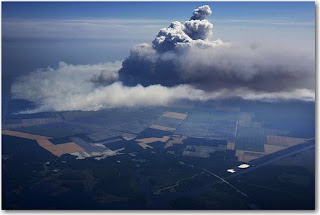
The Evans Road fire in North Carolina last night jumped containment lines and "made a 5-mile run" according to the NC Division of Forest Resources. The fire which tripled in size yesterday has now burned 10,000 acres in Hyde and Washington counties, and has spread onto the Pocosin Lakes National Wildlife Refuge.

UPDATE, December 29, 2008
The fire eventually burned over 40,000 acres. The last update on Inciweb on August 5 showed that it was 90% contained at 40,704 acres.

June 11
Ophir Fire
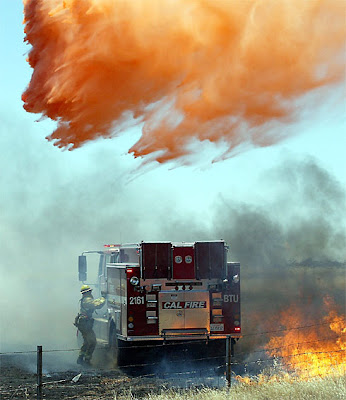
2 miles south of Oroville, California, 1,600 acres, 21 residences and 28 outbuildings lost. The spread of this fire has been stopped for now.

The photo of the Ophir fire below is courtesy of the Enterprise-Record.

June 12
California: Staffing shortages in USFS

An excerpt from a lengthy article in the Press-Enterprise:
By BEN GOAD
Washington Bureau

Roughly a third of California's fleet of federal fire engines is currently unavailable due to staffing shortages, according to figures supplied by a group that represents U.S. Forest Service crews.

Statewide, only 186 of the agency's 276 engines were ready to respond to fires as of Friday, according to a report created by fire officials and released by the Federal Wildland Fire Service Association.

June 14
California: Indians and Humbolt fires

On Wednesday a U.S. Forest Service engine from the Los Padres NF was burned over while they were attacking a spot fire on the Indians fire. From a news release by the USFS:
Narrative: At approximately 1615 hours while supporting a firing operation, Engine-71 was involved in a localized fire blow-up. A cyclonic fire wind event caused four members of Engine-71 to be overcome by the fire. The crew was suppressing spot fires near the roads edge when they experienced extreme fire and wind behavior.

Winds were estimated to be 60 – 70 mph. Limbs from large oak trees were blown out of trees and small, golf ball size rocks, were thrown into the air. The radiant heat caused the burns to the fire fighters. Initially, the firefighters were treated at the ICP medical unit, two were sent to a local hospital for further treatment and the most serious burn victim was flown to Valley Burn Center in Santa Clara. A fourth firefighter did not initially seek treatment. After further consideration, the 4th firefighter chose to see a physician. The three firefighters have been referred to the Fresno Burn Center for further examination.
June 16
Engine burnover near Lincoln, California

Another engine burnover--this time it was two Placer County Fire Department brush engines on the Nicolaus fire near Lincoln, CA on June 11. Here is an excerpt from CalFire's "24-hour report" recently released:
....Approximately seven minutes into the fire, E70 (IC) reported that units were being burned over. Appropriate EMS was requested.

The volunteer firefighter from BR 75 sought refuge on the leeward side of the apparatus. The fire intensity continued to increase and he retreated to safety, crossing a barbed wire fence, into a stubble field immediately to the east of the dirt road. He was met by apparatus and personnel from Lincoln Fire Department and escorted to ambulance personnel.

The CAL FIRE Firefighters from BR 73 tried to seek refuge in the cab, but were quickly overrun. They retreated through the flame front to the west, into the burn. Both of the firefighters walked north through the burn and exited where E70 was parked on Nicolaus Road.

All firefighters were treated and transported to UC Davis Medical Center. The volunteer firefighter from BR 75 received burns to the nose, was treated and released. The firefighters from BR 73 remain in the Burn Unit in stable condition with burns to the face and hands. They are expected to remain at UC Davis Medical Center for 7 to 10 days.
June 19
Firefighters' dirty drinking water, and "shift food"

The Missoula Technology and Development Center (MTDC) just published the 12th edition of the "Wildland Firefighter Health and Safety Report" written by Brian Sharkey (if you don't have the user name and password, go HERE):

Water bottles are filthy
Researchers found loads of nasty stuff in the water bottles and drinking systems of firefighters. They tested the bottles or systems of 15 firefighters and found that several of them had high concentrations of molds and yeasts. Legionella-like bacteria, which causes Legionnaires' disease, were detected in one water bottle and in one drinking tube.

June 21
National Geographic article about wildland fire

On May 16 Wildfire Today gave you a heads up about an article on wildland fire that would appear in the July issue of National Geographic. It should be arriving in mailboxes right now, but their web site has on online version of the article and some amazing pictures of fires. No one takes pictures like the NG photographers, and they did not disappoint this time. Here is an example (click on it to see a larger version):
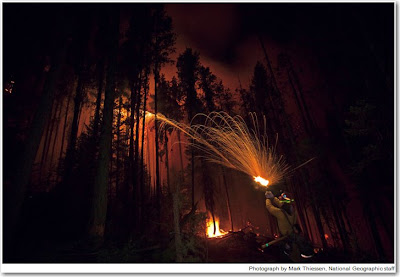
Photographer Mark Thiessen took most, if not all, of the photos--some of which can be found HERE. The online version of the article is here. It's lengthy, on ten web pages.

Be sure to read the interview with Thiessen about how he got the photos. One thing that helped....he has a red card and has shot photos of fires for 10 years.

June 21
More about Northern California lightning bust

From the reports I have seen, there are at least 300-400 fires that were started by the lightning that moved across the northern part of California from west to east during the last 24 hours. As this is written, lightning is still occurring in northeastern California.

Most of the fires are very small, their growth muted for a while by the overcast skies that brought the thunderstorms. But as the skies clear, smoke from a few large ones northwest of Redding and west of Ukiah is becoming visible in satellite photos. Only a small percentage of the fires are staffed and many new ones are being discovered every hour.

This situation is going to become dire unless the northern half of the state receives a great deal of rain in the next day or two. The weather forecast for the next several days at Redding shows temps in the low to mid 90's, moderate winds, minimum RH's in the high teens, and very little chance of rain.

It is starting to look like it could become another summer like the "Siege of 1987" when lightning in late August started 1,600 fires in northern California and southern Oregon that burned 650,000 acres. Some of the fires burned into October.

UPDATE, December 29, 2008
The 25,000 lightning strikes in northern California on June 20-21 started over 1,700 fires and as of July 4 had burned 520,831 acres.

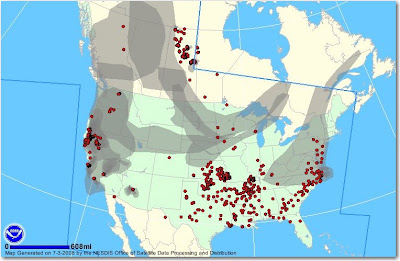
The smoke generated by the fires in California had a profound effect on residents in the northern part of the state for weeks. It also affected other portions of the country. Here is an example of a map showing smoke dispersal on July 3. The red dots are heat sources detected by satellites.

June 23
Fire near Big Sur closed coast highway

The Gallery fire, now part of the Basin Complex burning south of Big Sur in California, is now reported to be 2,000 acres. Judging from the satellite map below it is at least that big. The coast highway, Highway 1, had been closed by the fire. Now it is closed by a landslide.

The Indians fire, also shown on the map, is 56,044 acres. Yesterday firefighters did some burning out and according to a spokesperson "We had a really good day today". The heat shown on the map may be their burnout operations. It looks like there is a chance that Bill Molumby and his team may even catch this fire and it won't be another Los Padres wilderness fire that burns all summer.

UPDATE, December 29
The Indians fire eventually burned 76,554 acres after a large burnout operation along the Arroyo Seco river on the north side stopped the spread. The Basin Complex, which consumed 162,818 acres, burned into the Indians fire.

June 23
Clover fire, while still a WFU


I came across a map, above, of the Clover fire on the Sequoia National Forest, while it was still a Wildland Fire Use (WFU) fire on June 18. On the north and west sides, it was mostly hemmed in by previous fires that burned 2-4 years previously. On the east and southeast sides was an old 64-year old burn, and there was no fire history on the southwest side. The black line east of the fire is the Kern River.

Yesterday the fire crossed the Kern River, crested the Sierras, and burned east toward Hwy. 395

June 29
U.S. Forest Service's "Key Messages"

The U. S. Forest Service in California is aggressively trying to get certain messages out about the fire situation in northern California by issuing a laundry list containing 10 "Key Messages". They took the extraordinary step of having them inserted into the Northern California Geographic Area Coordination Center's "News and Notes", which usually contains just the bare facts and numbers about initial attacks and ongoing fires.

This may be in response to allegations by some that the USFS is losing many key firefighters to agencies that have much better pay and benefits packages, leaving the agency in California with too many unfilled positions and unstaffed engines.

Martin Mars lands at Lake Shasta

The third time proved to be the charm for the Canada-based Martin Mars air tanker. After having engine problems on Friday and Saturday, it successfully completed it's 4-hour trip to Lake Shasta north of Redding, California this morning. It will stage there until it receives an assignment, which will likely occur today, visibility permitting. On each mission it can drop 7,200 gallons of water, Thermogel, or water mixed with foam concentrate on a fire and then will refill it's tank by scooping water from a lake.

Wildfire Today covered the saga of this aircraft earlier, here and here.

The Martin Mars anchored on Lake Shasta, June 29. It has already been outfitted with an American flag and a USFS decal. Click on the photo to see a larger version. Photo courtesy of ShastaLake.com.

July 1
N.C.-- Eight firefighters struck by lightning

From WCNC.com--
LENOIR, N.C. -- Five firefighters are still in a hospital after being struck by lighting while battling a forest fire.

A total of eight firefighters with the North Carolina Forest Service were trying to contain the blaze Saturday, which was sparked by lighting the day before. The strike happened at 4:48 p.m.

Forestry officials believe the lightning bolt hit a tree; the energy radiated underground, where the firefighters were taking a break. They say the sky was clear blue at the time.

Initially, all eight firefighters were hospitalized. Doctors are treating the remaining five firefighters at Caldwell Memorial Hospital. Four of the eight are inmates who assist the forest service though a work release program.

(More information was posted later HERE.)

July 3
California: Two dozer rollovers

Two dozer operators rolled their dozers on Tuesday. One was wearing a seat belt and one was not.
A private contractor assigned to the Cold fire in Plumas County suffered a fractured skull, a dislocated shoulder and injuries to one ear when the bulldozer he was operating rolled over, said Dave Olson, a fire information officer for the Canyon Complex of fires on Plumas National Forest.

The employee of Oilar Agricultural Services, based in MacArthur, was flown to Enloe Medical Facility in Chico, where he was in stable condition Wednesday with no life-threatening injuries, Olson said.

In Siskiyou County, a contract operator was digging a fire line between the Alps Complex fire and the Ironside fire when his bulldozer rolled 80 feet down an embankment, said Alexis West, a fire information officer on the complex of fires burning on Shasta-Trinity National Forest.

The operator was wearing a seat belt, which probably saved his life, West said. He was taken to a Redding hospital, where he was treated for arm and shoulder injuries.

He was conscious and alert in Mercy Medical Center on Wednesday morning, West said.
July 5
Martin Mars reloads


I wonder what kind of wake the Martin Mars creates when it skims along a 3-mile stretch of Lake Shasta filling its 7,200 gallon tank at 80 miles per hour? It probably makes the lake a little choppy for the water skiers for a few minutes.

July 10
44 Australia and New Zealand firefighters coming to help the U.S.

On Saturday, U.S. time, 44 Australian and New Zealand firefighters will depart for the United States to assist with the wildland fires in California. The contingent will travel to the National Interagency Fire Center in Boise, Idaho for a briefing and to be issued equipment.

July 11
Basin fire burns around Tassajara

The Basin fire, east of Big Sur, made huge runs yesterday, burning completely around the Zen Center at Tassajara. It is now 108,026 acres and is 41% contained, adding about 18,000 acres over the last 24 hours.

July 17
Four men trapped, three burned on Motion fire

Four men wearing camouflage clothing were found in the Motion fire on the Whiskeytown National Recreation Area in northern California after one of them made a call in Spanish to 911. The area was burning vigorously and several strike teams of engines, hand crews, and dozers were staged along roads preparing for a burning operation.

Of the four Hispanic males, three of them had burn injuries. Jose Alcazar Fernandez, 25, was flown to Mercy Medical Center with third degree burns and was later transferred to the UC Davis burn unit. A second adult and a juvenile were transferred by ground ambulance, then treated for first and second degree burns and smoke inhalation and released. The juvenile male was treated and released for minor burns. The treated adult and a fourth adult male were arrested on federal charges of being present in a closed area.

Law enforcement officers determined that the men were Mexican nationals unlawfully present in the United States. They claimed to have been hunting in the park but refused to say where their weapons were. A marijuana cultivation site had been under investigation nearby and fire overhead and suppression personnel had repeatedly been briefed over the previous few days as to the specific location of the site and the probability of armed suspects in the area.

Firefighter rescues bear cub in fire, then begins treatment for rabies

Yesterday Wildfire Today brought you the story of the horse that was rescued by a crew on the Mill fire on the Mendocino National Forest. Now it's a bear.... a story not unlike the original Smokey Bear.

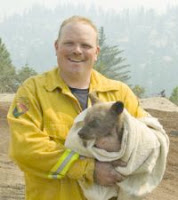
A Cal Fire Field Observer on the Moon fire in northern California, Adam Deem, found a bear cub while he was scouting the fire. The bear had some burns on his paws and was having difficulty walking. Deem looked for the cub's mother but could not find her, so he caught the bear and wrapped him in his brush jacket. In grabbing the cub, Deem received some scratches on his hands which required that he receive treatment for rabies.

Deem cradled the bear in his arms as he drove his pickup to a staging area. From there he and the cub were driven to the Incident Command Post in Anderson. Deem said on the way to the ICP he comforted, petted and sweet-talked the little cub.

At the ICP the Medical Unit treated the bear for dehydration and let him lick a lollipop before a state Fish & Game wildlife biologist picked it up for the trip to the Sacramento area rescue shelter.

UPDATE December 29, 2008
The bear, dubbed Li'l Smokey, is recovering well at the Lake Tahoe Wildlife Care center. He has his own blog and sometimes a live web cam that works occasionally. The Center expects to release him into the wild this winter.

July 26
Gunbarrel fire; largest Fire Use fire ever?
The Gunbarrel fire, east of Yellowstone National Park and west of Cody, Wyoming, started on July 26. For many weeks it was managed as a fire use fire, becoming one of the largest fire use fires ever. On August 24 it was converted to a suppression fire after it had burned 53,000 acres. The last reported size on Inciweb was 67,141 acres.

July 29
New Smokey Bear ad cancelled

On June 3 Wildfire Today told you about the new Smokey Bear public service announcements. An off road vehicle group complained that one of the ads seemed to imply that the legal use of an ATV could cause forest fires. Don Amador, the Western representative of the BlueRibbon Coalition in Idaho, said the ad:
"...incorrectly conveyed to the ATV rider that the best way for them to prevent wildfires was to stay at home. Instead, the ad should have encouraged the use of Forest Service-approved spark arresters and limiting travel to approved routes and areas."
The Forest Service has requested that TV stations discontinue using the ad.

July 31
Cascade fire update, Red Lodge, MT

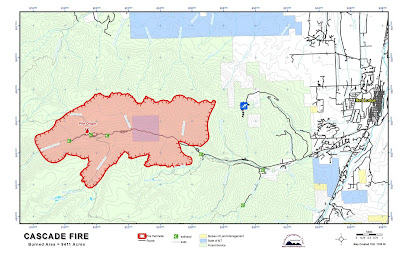
The Cascade fire, pushed by strong winds, grew substantially towards the east in the last 24 hours, from 5,936 to 9,411 acres. Late on Wednesday it was about a mile from the Red Lodge Mountain ski area and three miles west of Red Lodge, Montana. The Billings Gazette has an interesting article about the fire.

There is another article about Tom Moore, who lost a cabin in the Cascade fire and two years ago lost his house in a fire in Idaho.

The map was created at 5:00 p.m. on Wednesday.
HERE is the Inciweb page about the fire.

August 5

Firefighter "roughed up" by grizzly bear
The firefighter that was roughed up by the grizzly bear while working on the LeHardy fire in Yellowstone National Park is back at work.
Tony Allabastro, a member of the Lewis and Clark Forest Service hotshot crew based in Great Falls, reportedly saw the bear over his shoulder, coming from where his crew had been doing controlled burns, Sandy Hare, public information officer for the LeHardy fire, said Monday.

Before he had a chance to get his bear spray, the grizzly pounced on him and “roughed him up,” Hare said. The bear was “acting instinctually.”

“(The bear) just wanted out,” Hare said. “There was something in its way, and it happened to be a human.”

Allabastro got away with minimal injuries. He was treated at the Yellowstone Clinic in Lake, Wyo., for scratches and bruises Sunday and released.
[...]
Allabastro, who has fought wildfire for three seasons and served on a hotshot crew for one, was tackled by the grizzly while working on a burnout near Fishing Bridge.

To be continued-
The final installment, stories from September through December, will be in an article on January 1.

Thursday, July 17, 2008

Firefighter rescues bear cub in fire, then begins treatment for rabies

Yesterday Wildfire Today brought you the story of the horse that was rescued by a crew on the Mill fire on the Mendocino National Forest. Now it's a bear.... a story not unlike the original Smokey Bear.

A Cal Fire Field Observer on the Moon fire in northern California, Adam Deem, found a bear cub while he was scouting the fire. The bear had some burns on his paws and was having difficulty walking. Deem looked for the cub's mother but could not find her, so he caught the bear and wrapped him in his brush jacket. In grabbing the cub, Deem received some scratches on his hands.

Deem cradled the bear in his arms as he drove his pickup to a staging area. From there he and the cub were driven to the Incident Command Post in Anderson. Deem said on the way to the ICP he comforted, petted and sweet-talked the little cub.

At the ICP the Medical Unit treated the bear for dehydration and let him lick a lollipop before a state Fish & Game wildlife biologist picked it up for the trip to the Sacramento area rescue shelter.

Deem and the bear developed a good rapport. "He was giving me some kisses," Deem said.

Unfortunately, some of those licks were on Deem’s scratched hands, which later forced him to undergo preventative treatment for rabies at Shasta Regional Medical Center in Redding. Deem said he had to have five rabies shots, and will need four more shots through next month.

“It’s absolutely worth it,” Deem said. “I don’t think anyone could have left that animal out there in that condition.”

The original Smokey Bear was a cub that was burned in the El Capitan National Forest in New Mexico.

UPDATE @ 0900 PT, July 18, 2008

Thanks to Tyler Dawn who let us know in the comments that the local media has a video story of the incident HERE.

Tuesday, July 29, 2008

Wildfire news, July 29

UPDATE @ 6:00 p.m. MT, July 29

Cascade fire (west of Red Lodge Montana)

Five structures have been lost in the Camp Senia area, and one burned at the MSU research camp. The acreage has not been updated since the 5,800 figure was given yesterday. Here is more information from a 5 p.m. update from the incident management team:
Fire fighting efforts are focused on the north and east ends of the fire today. Hand crews on the west end of the drainage are working onto the north and south sides constructing line and flanking the fire along the ridge tops. Heavy timber, steep, rocky terrain and limited access from roads and water sources remain challenges to fire fighting efforts.

A RED FLAG WARNING has been issued for the fire area today. The change in the weather is anticipated to bring a cold front passing through the area with increased potential for higher winds and thunderstorms in the afternoon and evening Changing weather conditions bring a watch out for increased fire activity and the potential for rapid fire spread which would likely trigger additional evacuations toward Red Lodge. Pay attention to changing weather conditions and be prepared to leave if an evacuation is ordered.

An updated map from the Incident Management Team is now available. Click on the map below to see a larger version.

See below for more information about the Cascade fire.


Telegraph fire

The fire has been very active on the northeast and east sides today, moving closer to Yosemite National Park, which is now about 6-7 miles east of the fire. See below for a map and more information about the Telegraph fire.

Gunbarrel fire

While InciWeb says the fire is 625 acres, the Associated Press reports the Gunbarrel fire has burned 1,200 acres. Judging by the thermal imagery from the satellites, it is far more than 625 acres. See below for more information.

====================================

8:16 a.m. MT, July 29

Gunbarrel fire, Wyoming


The Gunbarrel fire, 38 miles west of Cody, Wyoming, grew from 232 acres to 800 in the last 24 hours. But it appears to be larger than that, judging from last night's satellite images. The fire is currently designated as a "fire use" fire, meaning it will not be suppressed, just monitored and herded around as long as it remains within a designated area. On InciWeb yesterday, the fire is described this way:
The fire is burning in heavy timber with lots of bug-killed trees. The hot, dry weather will continue, resulting in active fire behavior.
On the National Situation Report the Incident Management Team described it late yesterday as:
Backing fire with single and group tree torching and short-range spotting.
A "backing fire" that tripled in size. Hmmmm.

Gunbarrel fire, July 28, 2008

It is July 29, and there are still at least five to seven weeks of fire season left in that area. However, the fire is in a huge imperfect bowl (see satellite photo below), surrounded in some areas by slopes with little or no vegetation which will serve to slow or limit the spread of the fire. We will be interested to see if 1) the fire remains relatively small and within the bowl, and 2) if the designation is changed from a "fire use" fire to a full suppression fire. This fire will be fascinating to watch and Bill Hahnenberg's Fire Use Team will have their work cut out for them as they put together their Wildland Fire Implementation Plan.

The yellow, red, and orange dots on the map indicate the approximate extent of the fire, as detected by heat-sensing satellites. Click on the maps to see larger versions.


The map below shows both the Cascade fire west of Red Lodge, MT, and the Gunbarrel fire west of Cody, WY. The red dots are symbols for heat that was detected by satellites within the last 12 hours. But we have learned that the dots, which are supposed to represent the approximate extent of the fire, are not as accurate in their location as the cross-hatched polygons. So interpret the maps with a grain of salt. The green areas are national forests, and the purple area is Yellowstone National Park.

The Cascade fire

The fire is 7-8 miles west of Red Lodge, Montana, and will be influenced by a Red Flag Warning today. Thunderstorms along with strong wind gusts up to 40 mph and lightning are predicted. The fire was last reported on Monday as being 5,800 acres and 0% contained. A Type 1 Incident Management Team with Incident Commander Bennett began arriving yesterday.

A ski area is about 2 miles from the fire. From the Billings Gazette:
Red Lodge Mountain Resort is putting its snowmaking equipment to use in hopes of protecting the ski hill from the Cascade fire, burning less than two miles away in the West Fork of Rock Creek.

Ten guns, capable of spraying 85 gallons of water a minute are soaking the ground around chair lift terminals, motor rooms and the resort’s two lodges. The guns draw water from ponds near the top of the mountain.

“It looks like we’re making snow, but we’re just blowing water,” said Rob Ringer, general manager of the Red Lodge Mountain Resort.
The map below shows the Cascade fire looking toward the west. The ski area is in the foreground, and the yellow and red dots indicate the approximate extent of the fire. The road that goes up the main canyon through the fire is West Fork Road (NF 71).


Telegraph fire

The fire is just north of Mariposa, California and 7 to 8 miles west of the El Portal entrance to Yosemite National Park. As of Monday night the fire had crossed the Merced River and had consumed 29,600 acres. Containment was at 10%. Structures destroyed include 25 residences and 27 outbuildings. Over 3,400 firefighters and 400 engines are assigned.

Currently threatened are the communities of Mariposa, Midpines, Greeley Hill, Coulterville, El Portal, Morman Bar, Boot Jack, Mt Bullion Conservation Camp, the Mariposa Utility District water supply, 70 kv transmission line supporting Yosemite Valley, as well as Yosemite National Park and numerous communication/repeater towers. More information, including evacuation instructions, can be found at the CalFire web site.

From the CalFire "Fact Sheet" issued at 7:00 a.m. PT today:
The fire is making major runs in all directions thru thick stands of Manzanita, Chamise, and Oak. Extreme fire behavior was observed with flames lengths of up to 100 feet reported. Similar burning conditions are expected in the next 24 hours. The fire is moving into the Sierra and Stanislaus Forest, affecting 70kv transmission line providing power to Yosemite Valley. A firing operation in the Dogtown area may generate visible smoke over the next 24 hours.

HERE is a link to a CalFire map, produced very early Tuesday morning.

Rescued bear improving

On July 17 we covered the story of the injured bear that was rescued in a fire in northern California by firefighter Adam Deem. Since then the bear, dubbed "Little Smokey", has been undergoing treatment for his burns at the nonprofit Lake Tahoe Wildlife Care facility. The Redding Searchlight has the details HERE.

Tuesday, September 16, 2008

Wildfire News, September 16

Satellite Phone Surge

Satellite telephones are no longer rare in emergency management. Here is an excerpt of an article from Forbes.com:
Greg Ewert lives in Maryland, but Hurricane Ike has been keeping him up at night.

As executive vice president of global channel distribution for Iridium Satellite, Ewert aims to make sure that organizations ranging from the Red Cross to the Federal Emergency Management Agency (FEMA) have ready access to his firm's satellite phones.

The job has been getting tougher. Hurricanes Gustav and Ike have swelled demand, prompting Iridium to ship 6,200 phones over the past three weeks. Last week, as Ike bore down on the Texas coastline, the firm's call traffic in the region tripled. Two weeks ago, when Gustav swiped New Orleans, the company's Louisiana traffic doubled.

"Three different areas in the southern U.S. have been affected in the last 30 days," says Ewert. "We're calling into service more equipment than we have in past years."

So far, Iridium has managed to meet demand. The company's policy of keeping three months' inventory of phones prepared it for the recent run on handsets. It has been routing calls the way it normally does: through its network of 66 satellites and down through a "gateway" station in high-and-dry Tempe, Ariz. This sky infrastructure insulates Iridium's system from whatever is happening on the ground, be it a hurricane, earthquake, wildfire or civil uprising.

The hurricanes, grim as they are, highlight Iridium's recent achievements. Its frothy rise under Motorola (nyse: MOT - news - people ) and subsequent $5 billion bankruptcy in the late 1990s led many to write it off as a costly flop. New management and foreign investors resuscitated the company in 2000 as Iridium Satellite.

Iridium's goals have since come down to earth. It has 305,000 subscribers--much fewer than the 1 million it once pursued but enough to make it the world's fastest-growing mobile satellite services provider. Frost & Sullivan has declared Iridium's service more reliable than that of its closest competitor, Milpitas, Calif.-based Globalstar (nasdaq: GSAT - news - people ), for the past two years.
Cellphones used for emergencies

And speaking of emergency communication, Forbes has another article about the usefulness of cell phones to provide important information during emergencies. Here are some excerpts:
The Federal Communications Commission is developing a national mobile alert system for 2010. The messages, which will be distributed through the country's four largest carriers AT&T, Verizon, Sprint Nextel and T-Mobile will include "presidential" or national emergency alerts, weather and local emergency alerts and child abductions. In a statement, FCC commissioner Michael J. Copps praised the ability of mobile alerts to reach people who aren't near a TV set or radio or lack electricity.

The move follows the FCC's attempt to establish a public safety communications network on radio spectrum auctioned earlier this year. Such a network would enable police and emergency workers across the country to seamlessly communicate on wireless devices. The FCC has said it hopes to establish such a network within the next few years.
and...........
Mobile alerts--messages moving the other direction--are another way cellphones can save lives. Manhattan-based Send Word Now delivers millions of mobile alerts a year for corporate, academic and public sector clients including Wal-Mart, Boston University and the U.S. Postal Service. New York City is testing a Send Word Now program that combines emergency notifications with everyday warnings, such as traffic. Text alerts have been growing in popularity for the past two years, says chief executive officer Tony Schmitz. Reliability and speed are factors. Even when phone lines and cellular networks are clogged with traffic, text messages tend to get delivered, within minutes.

......Advocates say that mobile safety functions are getting smarter and more specific. Send Word Now can program messages to be distributed automatically as soon as its software detects an event or disaster, speeding up the process and removing human error. Some firms are attaching documents to text messages--perhaps a floor plan for evacuation or a list of emergency procedures for employees to follow.
Yellowstone conference

Even the Associated Press has picked up on the conference which begins on September 22 in Jackson Hole, Wyoming.
YELLOWSTONE NATIONAL PARK, Wyo. (AP) An international "Who's Who" of wildland fire management and science is set to gather in Jackson, Wyo., later this month to look back at the 1988 fires in Yellowstone National Park and the northern Rockies.

"The '88 Fires: Yellowstone and Beyond" is the subject of the park's Ninth Biennial Scientific Conference, to be held in Jackson from September 22 to 27.

Featured speakers include Norm Christensen, professor of ecology and founding dean of the Nicholas School at Duke University; Tom Zimmerman of the U.S. Forest Service Rocky Mountain Research Station; Cathy Whitlock of Montana State University; retired Yellowstone Superintendent Bob Barbee; Steve Frye of the Montana Department of Natural Resources and Conservation; and John Varley, executive Director of the Big Sky Institute at Montana State University.

Rescued bear update

CBS13 has an update on the bear cub that was rescued after being burned on a fire in northern
California.
Li'l Smokey," a black bear cub rescued by a firefighter while fleeing a Northern California wildfire, has taken a major step in his recovery.

The bear cub is now walking on bare paws! Doctors have decided to give Lil' Smokey a trial at walking around without bandages or booties on his burned paws. Workers at the Lake Tahoe Wildlife Care center say his paws are a bit red but that's to be expected.

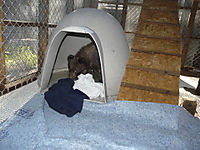
Smokey has also been moved to a new bigger cage with one screened side that means
he will be subjected to the natural weather outside. He also has a small igloo so he can "cozy down". Workers say he's already moved all his favorite toys and blankets inside the igloo.

Lil' Smokey now weighs 35.2 pounds meaning he's gained almost 25 pounds in the 8 and a half weeks at the center.

Doctors are also more optimistic that Smokey will actually be released back into the wild.

The cub, rescued by firefighter Adam Deem from a the "Moon Fire" near Redding on Thursday, July 17, likely stepped on scorching ground, and may have been burned by the flames.
Check out Smokey's blog.

NPR Series on fire in Yellowstone

National Public Radio's "Weekend Edition" is doing a series of five reports on fire in Yellowstone National Park called "Evolution of a National Treasure". Each one has a fairly short written version available on the Internet and also a 3 to 9 minute audio version. Four episodes are available so far:


Russians suspected in Georgia fire

Wildfire Today covered a similar incident on August 25, and it has apparently happened again. From UPI:
TSAGVERI, Georgia, Sept. 16 (UPI) -- Georgia says it has formed a commission to investigate whether Russian soldiers purposely started a forest fire in a popular national park.

Some witnesses near the Borjomi-Kharagauli National Park said they saw a
helicopter in the area on Aug. 15, only hours before Russia and Georgia signed a cease-fire halting the military conflict. Some said they saw "burning things" being dropped from the chopper onto the park, The Washington Post reported Tuesday.

The Georgian government commission says it will investigate if Russia deliberately started the forest fire, which has burned 2,500 acres of old-growth forest and crippled a major tourist attraction.

"I believe that yes, (the Russians) did it," said Revaz Enukidze, an official with Georgia's Environment Ministry, adding he thought the fire was started "to make as much as possible the economic and moral damage before the cease-fire."

"They know that this place is the treasure of the country," Natia Muladze of the park's visitor services told the Post. "Borjomi was full of Russians during the Soviet times, and they wanted to destroy the things which they could not take."
California: fire caused by marijuana farmers

I don't understand why fires caused by pot growers are so common. If you're doing something illegal, why start a fire that brings attention to what you're doing, shuts down your operation, and may lead to your arrest? But pot growers on public land are usually not the sharpest tools in the shed to start with. And, they are probably using "disposable" workers that are in the country illegally.

From CBS47.tv:
Madera County Sheriff's investigators say the wildfire burning near North Fork was caused by a sophisticated marijuana growing operation.

Investigators working on the Cascadel Fire discovered about 6,000 plants in multiple plots in the area. They also found a number of dead fish they suspect died from chemicals from the pot farm leaching into the pools.

Narcotic agents removed two pounds of processed marijuana and a total of 5,918 budding plants, with a combined street value worth nearly 18 million dollars.

The fire is now 70% contained and has already scorched 280 acres. Helicopters are still being used to drop water on hot spots but crews expect the blaze to be contained sometime on Tuesday.

Monday, August 18, 2008

Wildfire news, August 18

Several media outlets are jumping into the suppression or fire use issue. The latest is the Salt Lake Tribune.

The New York Times explores the contractor vs. federal employee issue. Along with others, they point out that of the nine that died in the August 8 helicopter crash, only one was a regular government employee. The other eight were contractors.

Activity on the Gunbarrel fire east of Yellowstone NP is expected to increase over the next few days, due to higher temperatures and lower humidities. This fire use fire, the largest ever in the Rocky Mountain area, has burned 42,148 acres.

A reminder..... the CBS Evening News is expected to run a story tonight, Monday night, about the bear cub that was rescued in a fire in northern California. The piece was scheduled to air August 14, but got bumped due to breaking news stories. HERE is a link to a blog about the bear. OK, so now we have an excuse to run the photo of Lil' Smokey again.


Late breaking news this afternoon--- a vegetation fire has spread to as many as eight homes on the north side of Reno, Nevada. KRNV says the vegetation fire is knocked down but the homes are still burning. A video report is HERE. A photographer wrote this on the KRNV site:
We were over getting ready to cover Wolf Pack football practice when we saw the smoke. Photographer Chuck King and I drove over to investigate and were the first crew on the scene.

I've never seen anything like that fire. It went from two homes to six+ in just minutes. Much credit has to go to the neighbors who were trying to help and the firefighters who risked their lives to keep this disaster as limited as they could.


UPDATE @ 8:25 P.M., August 18
The fire in Reno destroyed six houses and seriously damaged a seventh but only burned two acres. Some juveniles were seen running from the area about the time the fire started. The fire was in the Ridgecrest neighborhood where a fire destroyed four homes and damaged a fifth in 2004. That blaze was started by a pair of boys playing with fireworks.

Wednesday, August 13, 2008

Wildfire news, August 13

Rescued bear cub

The bear cub that was rescued by CalFire firefighter Adam Deem while working as a Field Observer on the Moon fire in northern California on July 17 is improving.
A badly blistered American black bear cub whose plight has touched the hearts of people around the world is continuing his recovery from second- and third-degree burns to his paws after his rescue last month from the hot embers of a Shasta-Trinity National Forest wildfire.

"His paws are definitely healing," Cheryl Millham, executive director of the nonprofit Lake Tahoe Wildlife Care, said Tuesday. "His toes are coming along beautifully."

Affectionately called "Li'l Smokey," the approximately 6-month-old bear cub, who also was badly dehydrated, weighed only about 8 pounds when a California Department of Forestry and Fire Protection firefighter plucked him from the scalding ashes of the Moon Fire.

He now weighs more than 16 pounds.

It's hoped that Li'l Smokey's severe burns will heal well enough that he can be released back into the Shasta-Trinity National Forest during next year’s hibernation season, Millham said.
The rest of the story is at the Redding Searchlight. The article says regular updates are at the Lake Tahoe Wildlife Care website, but we could not find any on the site.

UPDATE, August 14: We received an email from the LTWC folks. Lil' Smokey has a blog which includes updates.

Emotional recovery from helicopter crash

The Mail Tribune has an article about the road to emotional recovery for the people affected by the helicopter crash that killed 9 firefighters on August 5. Here is a brief excerpt:
The road to emotional recovery could be a long one for those close to the nine people who died in the Aug. 5 helicopter crash at a wildfire in the Shasta-Trinity National Forest in Northern California, a mental health expert says.

"For the people who have an event like this happen around them or to them, this changes them, probably for the rest of their lives," observed Vard Miller, 61, a clinical social worker in charge of the critical incident teams for the U.S. Forest Service's Region 6.

"There are actual brain changes as the result of traumatic events," added Miller, who fought wildfires in his younger years. "Sometimes they never totally, fully recover in the sense that there can be a small incident that will trigger those memories and feelings."

This week Miller has been meeting with firefighters and others connected to the crash of the Merlin-based Carson Helicopters Inc. aircraft that killed the pilot, a U.S. Forest Service aviation expert and seven firefighters from Grayback Forestry Inc., which has offices in White City and Merlin.
Grayback Forestry video

Here is a video from August 8 in which Grayback Forestry President Mike Wheelock provides some of the initial information about the victims of the August 5 helicopter crash.

Friday, February 6, 2009

Li'l Smokey the bear cub--released

Li'l Smokey recovering from the anesthetic in his new den. Redding Searchlight

Li'l Smokey, the bear cub that was rescued by a CalFire firefighter after being burned in a fire in northern California, has been released back into the wild. Adam Deem, who found the bear, was able to witness the release at a remote site described as excellent bear habitat.

Smokey, who is now about a year old and weighs 100 pounds, was cared for at the Lake Tahoe Wildlife Care center after suffering burns to his paws. More information is at Li'l Smokey's blog and photos are at the Redding Searchlight.

Friday, August 15, 2008

Wildfire news, August 15

Training to resume at bombing range in NJ

The New Jersey Air National Guard will resume some training in October at a bombing range that was the source of a 17,000 acre fire on May 15, 2007. Here is what we wrote about the fire on January 10, 2008:
On May 15, 2007, a New Jersey Air National Guard F-16 ejected a flare during a low-level pass on a training flight, starting a fire which grew to 17,000 acres. The fire destroyed four homes in two senior citizen housing developments, and damaged 37 others. Some 6,000 people were evacuated. Ocean County agencies will receive $320,000 from the Air Force as reimbursements for their costs during the fire. The Air Force has already paid nearly $2 million in private property claims and other losses, but many claims are still unsettled.


USFA Releases Firefighter Fatalities Report

The United States Fire Administration released "Firefighter Fatalities in the United States in 2007," an annual report of on-duty firefighter fatalities in the United States. There were 118 on-duty deaths in 2007 in the United States.

Of the 118 firefighters that died while on duty in 2007:

  • 68 volunteer firefighters and 50 career firefighters died while on duty.
  • There were seven firefighter fatality incidents where two or more firefighters were killed, claiming a total of 21 firefighters' lives.
  • 11 firefighters were killed during activities involving brush, grass or wildland fires, the lowest in over a decade.
  • Activities related to emergency incidents resulted in the deaths of 76 firefighters.
  • 38 firefighters died while engaging in activities at the scene of a fire.
  • 26 firefighters died while responding to or returning from emergency incidents.
  • 11 firefighters died while they were engaged in training activities.
  • 15 firefighters died after the conclusion of their on-duty activity.
  • Heart attacks were the most frequent cause of death for 2007, with 52 firefighter deaths.
The full report can be downloaded at http://www.usfa.dhs.gov/fireservice/fatalities/statistics/report.shtm.

From Firechief.com

Li'l Smokey to be on CBS News

The bear cub that was rescued by CalFire firefighter Adam Deem on the Moon fire on July 17 will be featured on the CBS Evening News on Monday. The piece was scheduled to air yesterday, but got bumped due to breaking news stories. HERE is a link to a blog about the bear.


Photo courtesy of Lake Tahoe Wildlife Care

Sunday, October 19, 2008

Wildfire news, October 19

Oregon forests protected by cameras

From NRToday.com:
The Oregon Department of Forestry has recognized four Douglas Forest Protective Association employees for their innovative work in fire detection.

The employees were presented a team award recently for their research and implementation of a video fire detection system that is receiving national attention, according to a DFPA press release.

The forestry department’s Southern Oregon area director nominated the team for the award. The DFPA employees are District Manager Melvin Thornton, Project Manager Scott Jackson, Staff Forester Dennis Sifford and Geographic Information System Specialist George Day.

Thornton began researching the camera system in 2005 because the association’s traditional lookout structures were in need of repair or replacement. Thornton sought a less expensive alternative to replacing the structures, which can cost more than $300,000, according to the press release.

DFPA began testing out the cameras in 2006 and now has eight cameras monitoring the 1.6 million-acre district. The cameras transmit video images to the DFPA office in Roseburg and sound alarms if a column of smoke is detected.

They can rotate 360 degrees every six minutes while providing an operator with the ability to zoom in for a closer look.

Each camera costs about a tenth of the price of a new lookout station.

Five cameras are also now in use throughout the Umpqua National Forest, Coos Forest Protective Association and surrounding department of forestry districts, according to the press release.

DFPA’s headquarters serves as the detection center for all the sites.
Update on Li'l Smokey

The bear cub that was rescued from the fire in northern California is doing better and is still being cared for at Lake Tahoe Wildlife Care. When rescued, he weighed 8 pounds. He now weighs 56 pounds.

Not only does Li'l Smokey have a Blog, but he even has a web cam.


Video of two fire trucks colliding

Firegeezer has the details here and here about the collision between two fire trucks in St. Louis, but this 12-second video is amazing. It was taken by a camera designed to catch vehicles running a red light. It is a good topic for a tailgate safety meeting. This camera could not have been positioned in a better spot to catch this accident. It almost looks like a scene from a movie.

Thankfully, all of the 8 firefighters were wearing seat belts and there were no serious injuries, except for the one firefighter who was kept overnight in the hospital for a concussion.

UPDATE @ 9:48 a.m., Oct. 24: the video has been pulled from YouTube, possibly at the request of the City of St. Louis. But Firegeezer has a copy of it squirreled away HERE.

Thursday, January 15, 2009

Book about rescued bear cub

The CalFire firefighter who rescued the "Lil' Smokey" bear cub on the fire in northern California last summer is writing a book about the experience. The cub's paws are almost healed and the rescue center expects to release him back into the wild this winter.

Here is a link to a 34-second news video about the book and the bear.

Tuesday, August 19, 2008

Lil' Smokey video

CBS Evening News aired the 3-minute segment yesterday on the bear cub that was rescued on the fire in northern California. In case you missed it, here it is.