.

Showing posts sorted by date for query hayman fire. Sort by relevance Show all posts

Wednesday, December 31, 2008

Top Wildland Fire News Stories: May-Aug., 2008

We have been busy with end-of-the-year wrap-ups.

On Monday we posted a list of fatalities on wildland fires. After combing through the 800+ posts on Wildfire Today during 2008, on Tuesday, December 30, we listed the top stories for January-April. Today we'll cover May-August, and on January 1, September-December.

Posted below are excerpts from the articles. To read the entire articles, click on the links.

May 10
California: Schwarzenegger's fire preparedness

The California governor seems to be concerned about the wildfire potential this summer. In a press conference he was talking about the fire hazards around his home:
"I was not aware of it until an expert from the fire department told me that, 'This is terrible. This is a fire hazard all around your house -- you are living in the middle of it, get rid of this grass, get rid of these shrubs or you are going to be in trouble.'
He issued a lengthy Executive Order that detailed numerous policies that will affect CalFire this year. Here are some of the highlights:Staff additional fire crews, fire engines, helitack crews, fire bulldozers, equipment and aviation resources as warranted based on fire threat conditions.

May 12
"Wildland Firefighter" demobilizes

Wildland Firefighter magazine just announced in it's May issue that it is ceasing publication. It will no longer exist as a stand-alone publication dedicated to wildland fire. In a publisher's note, Jeff Berend, the Vice President and Publisher said:
"Beginning in June, we will be merging Wildland Firefighter into a new Wildland/Urban Interface (WUI) section in FireRescue magazine.....

But from a business perspective, we simply have not been able to grow the readership or advertising beyond that loyal core. At the same time, publishing costs have risen at unprecedented levels."
Wildland Firefighter and FireRescue are both published by Elsevier Public Safety. Wildland Firefighter became the "official publication of the International Association of Fire Chiefs" a couple of years ago after the IAFC severed their relationship with Fire Chief magazine.

This leaves Wildfire magazine, an "official publication of the International Association of Wildland Fire" as the only remaining magazine-type publication dedicated solely to wildland fire.

May 28
Increased risk of bladder cancer for firefighters

It seems like there are more and more chronic diseases that firefighters are predisposed to get. Now you can add bladder cancer to the list.

ScienceDaily (May 15, 2008) — A new study presented at the Annual Scientific Meeting of the American Urological Association (AUA) suggests that firefighters may be at an increased risk of developing transitional cell carcinoma (TCC, or bladder cancer) and should be considered for routine annual screening. Currently, no guidelines exist for regular TCC screening.

May 29
Montana: two firefighters struck by lightning

Two firefighters working on a prescribed fire on the Flathead National Forest were struck by lightning Thursday. They were on on the Tally Lake Ranger District when lighting struck some trees near where they were working. The firefighters, a 25-year old woman and a 29-year old man are members of a Hot Shot crew. Both were both transported to hospitals, the woman by helicopter and the man by ambulance. They are listed in stable condition.

May 30
San Diego Grand jury issues scathing report about fire preparedness

The Grand Jury of San Diego County investigated the response to the Witch Creek and Guejito fires of last fall that burned 368,340 acres, destroyed 2,653 structures, and claimed the lives of 10 citizens . They just issued their report and it pulls no punches.

June 2
Terry Barton released from prison

Terry Barton, convicted of starting the 138,000 acre Hayman fire in 2003, was released from prison this morning. She started the fire while she worked as a Fire Prevention Technician on the Pike National Forest in Colorado.

The fire burned 133 homes and forced 8,000 people to evacuate, including the judge who presided over one of the proceedings related to the case. She served six years in a federal prison in Fort Worth, Texas.

Wildfire Today covered other aspects of this story HERE.

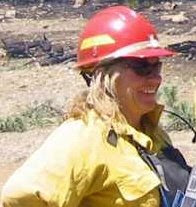
The picture is from 2002 when she appeared in court, courtesy of the Denver Post.

June 3
Fire season outlook for Washington

The Wenatchee World web site has an interesting story about the outlook for fire activity in north central Washington state this year.
Officials say other than a late start to the season, there are no strong indicators for predicting this year's season.

"We're always going to have a fire season. And it's always going to depend on how receptive (fuels) are to ignition, and then, do we get ignition," said Bobbie Scopa, fire management officer for the Okanogan-Wenatchee National Forests.

Scopa said the season will partly depend on June rains, although lots of rain can mean high grasses, which dry out quickly in hot weather and allow for a fast-spreading fire. Mostly, she said, it will depend on the number of fires started by lightning storms, escaped campfires or vehicles and equipment without spark arresters.

Scopa said snowpack may help determine when the fire season will start but isn't always an indicator of the severity of the season. She pointed to 2005, one of the driest winters on record, when North Central Washington saw little fire activity. That was followed by 2006, when a winter with heavy snowpack melted into a summer with the 175,000-acre Tripod Fire — the largest wildfire in the region's history.

"It's pretty tough to make too big a prediction," she said.
However, Rick Ochoa, a meteorologist working at NICC in Boise, said:
"...the cooler spring weather and heavy snowpack do mean that overall there's a slimmer chance that the Northwest will have numerous large fires."
Ochoa further goes out on a limb to predict:
"...the Northwest will see 473 fires, burning 17,873 acres by the end of June. That's compared with an average for June 30 of 605 fires burning 24,508 acres."
UPDATE, December 29, 2008
For the 12-year period, 1985-2006, in the Northwest Geographic Area, there were an average of 6,774 fires per year for a total average acreage of 627,884. The average size of the fires was 93 acres.

In 2008, through October 7, there were 3,927 fires for a total acreage of 289,853. The average size of the fires was 73 acres.

June 4
Fire in North Carolina makes 5-mile run

The Evans Road fire in North Carolina last night jumped containment lines and "made a 5-mile run" according to the NC Division of Forest Resources. The fire which tripled in size yesterday has now burned 10,000 acres in Hyde and Washington counties, and has spread onto the Pocosin Lakes National Wildlife Refuge.

UPDATE, December 29, 2008
The fire eventually burned over 40,000 acres. The last update on Inciweb on August 5 showed that it was 90% contained at 40,704 acres.

June 11
Ophir Fire
2 miles south of Oroville, California, 1,600 acres, 21 residences and 28 outbuildings lost. The spread of this fire has been stopped for now.

The photo of the Ophir fire below is courtesy of the Enterprise-Record.


June 12
California: Staffing shortages in USFS

An excerpt from a lengthy article in the Press-Enterprise:
By BEN GOAD
Washington Bureau

Roughly a third of California's fleet of federal fire engines is currently unavailable due to staffing shortages, according to figures supplied by a group that represents U.S. Forest Service crews.

Statewide, only 186 of the agency's 276 engines were ready to respond to fires as of Friday, according to a report created by fire officials and released by the Federal Wildland Fire Service Association.

June 14
California: Indians and Humbolt fires

On Wednesday a U.S. Forest Service engine from the Los Padres NF was burned over while they were attacking a spot fire on the Indians fire. From a news release by the USFS:
Narrative: At approximately 1615 hours while supporting a firing operation, Engine-71 was involved in a localized fire blow-up. A cyclonic fire wind event caused four members of Engine-71 to be overcome by the fire. The crew was suppressing spot fires near the roads edge when they experienced extreme fire and wind behavior.

Winds were estimated to be 60 – 70 mph. Limbs from large oak trees were blown out of trees and small, golf ball size rocks, were thrown into the air. The radiant heat caused the burns to the fire fighters. Initially, the firefighters were treated at the ICP medical unit, two were sent to a local hospital for further treatment and the most serious burn victim was flown to Valley Burn Center in Santa Clara. A fourth firefighter did not initially seek treatment. After further consideration, the 4th firefighter chose to see a physician. The three firefighters have been referred to the Fresno Burn Center for further examination.
June 16
Engine burnover near Lincoln, California

Another engine burnover--this time it was two Placer County Fire Department brush engines on the Nicolaus fire near Lincoln, CA on June 11. Here is an excerpt from CalFire's "24-hour report" recently released:
....Approximately seven minutes into the fire, E70 (IC) reported that units were being burned over. Appropriate EMS was requested.

The volunteer firefighter from BR 75 sought refuge on the leeward side of the apparatus. The fire intensity continued to increase and he retreated to safety, crossing a barbed wire fence, into a stubble field immediately to the east of the dirt road. He was met by apparatus and personnel from Lincoln Fire Department and escorted to ambulance personnel.

The CAL FIRE Firefighters from BR 73 tried to seek refuge in the cab, but were quickly overrun. They retreated through the flame front to the west, into the burn. Both of the firefighters walked north through the burn and exited where E70 was parked on Nicolaus Road.

All firefighters were treated and transported to UC Davis Medical Center. The volunteer firefighter from BR 75 received burns to the nose, was treated and released. The firefighters from BR 73 remain in the Burn Unit in stable condition with burns to the face and hands. They are expected to remain at UC Davis Medical Center for 7 to 10 days.
June 19
Firefighters' dirty drinking water, and "shift food"

The Missoula Technology and Development Center (MTDC) just published the 12th edition of the "Wildland Firefighter Health and Safety Report" written by Brian Sharkey (if you don't have the user name and password, go HERE):

Water bottles are filthy
Researchers found loads of nasty stuff in the water bottles and drinking systems of firefighters. They tested the bottles or systems of 15 firefighters and found that several of them had high concentrations of molds and yeasts. Legionella-like bacteria, which causes Legionnaires' disease, were detected in one water bottle and in one drinking tube.

June 21
National Geographic article about wildland fire

On May 16 Wildfire Today gave you a heads up about an article on wildland fire that would appear in the July issue of National Geographic. It should be arriving in mailboxes right now, but their web site has on online version of the article and some amazing pictures of fires. No one takes pictures like the NG photographers, and they did not disappoint this time. Here is an example (click on it to see a larger version):

Photographer Mark Thiessen took most, if not all, of the photos--some of which can be found HERE. The online version of the article is here. It's lengthy, on ten web pages.

Be sure to read the interview with Thiessen about how he got the photos. One thing that helped....he has a red card and has shot photos of fires for 10 years.

June 21
More about Northern California lightning bust

From the reports I have seen, there are at least 300-400 fires that were started by the lightning that moved across the northern part of California from west to east during the last 24 hours. As this is written, lightning is still occurring in northeastern California.

Most of the fires are very small, their growth muted for a while by the overcast skies that brought the thunderstorms. But as the skies clear, smoke from a few large ones northwest of Redding and west of Ukiah is becoming visible in satellite photos. Only a small percentage of the fires are staffed and many new ones are being discovered every hour.

This situation is going to become dire unless the northern half of the state receives a great deal of rain in the next day or two. The weather forecast for the next several days at Redding shows temps in the low to mid 90's, moderate winds, minimum RH's in the high teens, and very little chance of rain.

It is starting to look like it could become another summer like the "Siege of 1987" when lightning in late August started 1,600 fires in northern California and southern Oregon that burned 650,000 acres. Some of the fires burned into October.

UPDATE, December 29, 2008
The 25,000 lightning strikes in northern California on June 20-21 started over 1,700 fires and as of July 4 had burned 520,831 acres.

The smoke generated by the fires in California had a profound effect on residents in the northern part of the state for weeks. It also affected other portions of the country. Here is an example of a map showing smoke dispersal on July 3. The red dots are heat sources detected by satellites.


June 23
Fire near Big Sur closed coast highway

The Gallery fire, now part of the Basin Complex burning south of Big Sur in California, is now reported to be 2,000 acres. Judging from the satellite map below it is at least that big. The coast highway, Highway 1, had been closed by the fire. Now it is closed by a landslide.

The Indians fire, also shown on the map, is 56,044 acres. Yesterday firefighters did some burning out and according to a spokesperson "We had a really good day today". The heat shown on the map may be their burnout operations. It looks like there is a chance that Bill Molumby and his team may even catch this fire and it won't be another Los Padres wilderness fire that burns all summer.

UPDATE, December 29
The Indians fire eventually burned 76,554 acres after a large burnout operation along the Arroyo Seco river on the north side stopped the spread. The Basin Complex, which consumed 162,818 acres, burned into the Indians fire.

June 23
Clover fire, while still a WFU


I came across a map, above, of the Clover fire on the Sequoia National Forest, while it was still a Wildland Fire Use (WFU) fire on June 18. On the north and west sides, it was mostly hemmed in by previous fires that burned 2-4 years previously. On the east and southeast sides was an old 64-year old burn, and there was no fire history on the southwest side. The black line east of the fire is the Kern River.

Yesterday the fire crossed the Kern River, crested the Sierras, and burned east toward Hwy. 395

June 29
U.S. Forest Service's "Key Messages"

The U. S. Forest Service in California is aggressively trying to get certain messages out about the fire situation in northern California by issuing a laundry list containing 10 "Key Messages". They took the extraordinary step of having them inserted into the Northern California Geographic Area Coordination Center's "News and Notes", which usually contains just the bare facts and numbers about initial attacks and ongoing fires.

This may be in response to allegations by some that the USFS is losing many key firefighters to agencies that have much better pay and benefits packages, leaving the agency in California with too many unfilled positions and unstaffed engines.

Martin Mars lands at Lake Shasta

The third time proved to be the charm for the Canada-based Martin Mars air tanker. After having engine problems on Friday and Saturday, it successfully completed it's 4-hour trip to Lake Shasta north of Redding, California this morning. It will stage there until it receives an assignment, which will likely occur today, visibility permitting. On each mission it can drop 7,200 gallons of water, Thermogel, or water mixed with foam concentrate on a fire and then will refill it's tank by scooping water from a lake.

Wildfire Today covered the saga of this aircraft earlier, here and here.

The Martin Mars anchored on Lake Shasta, June 29. It has already been outfitted with an American flag and a USFS decal. Click on the photo to see a larger version. Photo courtesy of ShastaLake.com.

July 1
N.C.-- Eight firefighters struck by lightning

From WCNC.com--

LENOIR, N.C. -- Five firefighters are still in a hospital after being struck by lighting while battling a forest fire.

A total of eight firefighters with the North Carolina Forest Service were trying to contain the blaze Saturday, which was sparked by lighting the day before. The strike happened at 4:48 p.m.

Forestry officials believe the lightning bolt hit a tree; the energy radiated underground, where the firefighters were taking a break. They say the sky was clear blue at the time.

Initially, all eight firefighters were hospitalized. Doctors are treating the remaining five firefighters at Caldwell Memorial Hospital. Four of the eight are inmates who assist the forest service though a work release program.

(More information was posted later HERE.)

July 3
California: Two dozer rollovers

Two dozer operators rolled their dozers on Tuesday. One was wearing a seat belt and one was not.
A private contractor assigned to the Cold fire in Plumas County suffered a fractured skull, a dislocated shoulder and injuries to one ear when the bulldozer he was operating rolled over, said Dave Olson, a fire information officer for the Canyon Complex of fires on Plumas National Forest.

The employee of Oilar Agricultural Services, based in MacArthur, was flown to Enloe Medical Facility in Chico, where he was in stable condition Wednesday with no life-threatening injuries, Olson said.

In Siskiyou County, a contract operator was digging a fire line between the Alps Complex fire and the Ironside fire when his bulldozer rolled 80 feet down an embankment, said Alexis West, a fire information officer on the complex of fires burning on Shasta-Trinity National Forest.

The operator was wearing a seat belt, which probably saved his life, West said. He was taken to a Redding hospital, where he was treated for arm and shoulder injuries.

He was conscious and alert in Mercy Medical Center on Wednesday morning, West said.
July 5
Martin Mars reloads


I wonder what kind of wake the Martin Mars creates when it skims along a 3-mile stretch of Lake Shasta filling its 7,200 gallon tank at 80 miles per hour? It probably makes the lake a little choppy for the water skiers for a few minutes.

July 10
44 Australia and New Zealand firefighters coming to help the U.S.

On Saturday, U.S. time, 44 Australian and New Zealand firefighters will depart for the United States to assist with the wildland fires in California. The contingent will travel to the National Interagency Fire Center in Boise, Idaho for a briefing and to be issued equipment.

July 11
Basin fire burns around Tassajara

The Basin fire, east of Big Sur, made huge runs yesterday, burning completely around the Zen Center at Tassajara. It is now 108,026 acres and is 41% contained, adding about 18,000 acres over the last 24 hours.

July 17
Four men trapped, three burned on Motion fire

Four men wearing camouflage clothing were found in the Motion fire on the Whiskeytown National Recreation Area in northern California after one of them made a call in Spanish to 911. The area was burning vigorously and several strike teams of engines, hand crews, and dozers were staged along roads preparing for a burning operation.

Of the four Hispanic males, three of them had burn injuries. Jose Alcazar Fernandez, 25, was flown to Mercy Medical Center with third degree burns and was later transferred to the UC Davis burn unit. A second adult and a juvenile were transferred by ground ambulance, then treated for first and second degree burns and smoke inhalation and released. The juvenile male was treated and released for minor burns. The treated adult and a fourth adult male were arrested on federal charges of being present in a closed area.

Law enforcement officers determined that the men were Mexican nationals unlawfully present in the United States. They claimed to have been hunting in the park but refused to say where their weapons were. A marijuana cultivation site had been under investigation nearby and fire overhead and suppression personnel had repeatedly been briefed over the previous few days as to the specific location of the site and the probability of armed suspects in the area.

Firefighter rescues bear cub in fire, then begins treatment for rabies

Yesterday Wildfire Today brought you the story of the horse that was rescued by a crew on the Mill fire on the Mendocino National Forest. Now it's a bear.... a story not unlike the original Smokey Bear.

A Cal Fire Field Observer on the Moon fire in northern California, Adam Deem, found a bear cub while he was scouting the fire. The bear had some burns on his paws and was having difficulty walking. Deem looked for the cub's mother but could not find her, so he caught the bear and wrapped him in his brush jacket. In grabbing the cub, Deem received some scratches on his hands which required that he receive treatment for rabies.

Deem cradled the bear in his arms as he drove his pickup to a staging area. From there he and the cub were driven to the Incident Command Post in Anderson. Deem said on the way to the ICP he comforted, petted and sweet-talked the little cub.

At the ICP the Medical Unit treated the bear for dehydration and let him lick a lollipop before a state Fish & Game wildlife biologist picked it up for the trip to the Sacramento area rescue shelter.

UPDATE December 29, 2008
The bear, dubbed Li'l Smokey, is recovering well at the Lake Tahoe Wildlife Care center. He has his own blog and sometimes a live web cam that works occasionally. The Center expects to release him into the wild this winter.

July 26
Gunbarrel fire; largest Fire Use fire ever?
The Gunbarrel fire, east of Yellowstone National Park and west of Cody, Wyoming, started on July 26. For many weeks it was managed as a fire use fire, becoming one of the largest fire use fires ever. On August 24 it was converted to a suppression fire after it had burned 53,000 acres. The last reported size on Inciweb was 67,141 acres.

July 29
New Smokey Bear ad cancelled

On June 3 Wildfire Today told you about the new Smokey Bear public service announcements. An off road vehicle group complained that one of the ads seemed to imply that the legal use of an ATV could cause forest fires. Don Amador, the Western representative of the BlueRibbon Coalition in Idaho, said the ad:
"...incorrectly conveyed to the ATV rider that the best way for them to prevent wildfires was to stay at home. Instead, the ad should have encouraged the use of Forest Service-approved spark arresters and limiting travel to approved routes and areas."
The Forest Service has requested that TV stations discontinue using the ad.

July 31
Cascade fire update, Red Lodge, MT

The Cascade fire, pushed by strong winds, grew substantially towards the east in the last 24 hours, from 5,936 to 9,411 acres. Late on Wednesday it was about a mile from the Red Lodge Mountain ski area and three miles west of Red Lodge, Montana. The Billings Gazette has an interesting article about the fire.

There is another article about Tom Moore, who lost a cabin in the Cascade fire and two years ago lost his house in a fire in Idaho.

The map was created at 5:00 p.m. on Wednesday.

HERE is the Inciweb page about the fire.

August 5

Firefighter "roughed up" by grizzly bear
The firefighter that was roughed up by the grizzly bear while working on the LeHardy fire in Yellowstone National Park is back at work.
Tony Allabastro, a member of the Lewis and Clark Forest Service hotshot crew based in Great Falls, reportedly saw the bear over his shoulder, coming from where his crew had been doing controlled burns, Sandy Hare, public information officer for the LeHardy fire, said Monday.

Before he had a chance to get his bear spray, the grizzly pounced on him and “roughed him up,” Hare said. The bear was “acting instinctually.”

“(The bear) just wanted out,” Hare said. “There was something in its way, and it happened to be a human.”

Allabastro got away with minimal injuries. He was treated at the Yellowstone Clinic in Lake, Wyo., for scratches and bruises Sunday and released.
[...]
Allabastro, who has fought wildfire for three seasons and served on a hotshot crew for one, was tackled by the grizzly while working on a burnout near Fishing Bridge.

To be continued-
The final installment, stories from September through December, will be in an article on January 1.

Monday, December 15, 2008

Reports: Colo. Sen. Salazar to be Sec. of Interior

Multiple media sources are reporting that President Elect Obama will nominateColorado Senator Ken Salazar to be Secretary of Interior. The Department of Interior oversees four large land management agencies having wildland fire responsibilities: National Park Service, Fish and Wildlife Service, Bureau of Land Management, and the Bureau of Indian Affairs.

The LA Times:
Sen. Ken Salazar (D-Colo.), a Latino with deep knowledge of water and land issues, is President-elect Barack Obama's choice to lead the Interior Department.

Two senior Democrats confirmed Monday that Obama will name Salazar to the post, rounding out an energy and environmental policy team announced at a Chicago news conference.

The Senate's confirmation of Salazar would probably put the brakes on several controversial Interior Department decisions on energy development.

The department oversees national parks and other large swaths of public lands, and sets policy for oil and gas drilling, mining and other resource extraction.

Earlier this year, Salazar criticized the department for decisions to open Colorado's picturesque Roan Plateau for drilling. Salazar said the regulations to begin opening land for oil shale development would "sell Colorado short."

[...]

Salazar led Colorado's Department of Natural Resources and served as the state's attorney general before winning a vacant Senate seat in 2004. He entered Congress in the same freshman class as Obama.
More information about Senator Salazar:

From his web site:
In Colorado, we are all too familiar with the destruction wrought by wildfires. We can all remember the Hayman wildfire in the summer of 2002 that burned nearly 138,000 acres over the course of three weeks and forced over 40,000 people to evacuate their homes while leaving 133 Coloradans homeless.

Last week, the Senate Energy and Natural Resources Committee, of which I am a member, held a hearing to discuss the potential link between a changing global climate and increased wildfire activity in the United States. Climate change is increasingly being cited by scientists as the cause for our more frequent and severe wildfires.
The Denver Post, July 7, 2006:
Sen. Ken Salazar complained Wednesday that lack of money has stymied most of the projects to treat bark beetle-damaged forests in Colorado to reduce wildfire risk.

"I look at Colorado as the Katrina of the West," Salazar said. "We are simply not doing enough."

Salazar's criticism came as senators from Western states scolded Bush administration officials for what they said was the slow pace of efforts to decrease the risk of catastrophic fires.
On November 19, 2008 he wrote a letter to the Chief of the U.S. Forest Service providing advice about how funds should be spent for hazardous fuels management.

In 2007 he co-sponsored with Senator Maria Cantwell a bill called the Wildland Fire Safety and Transparency Act of 2007. The bill, which did not pass, would have created a great deal of meaningless, rote, ritualized, paperwork for the four large federal land management agencies.

The bill would have required the federal agencies to:
...jointly submit annual reports to Congress on the wildland firefighter safety practices of the Secretaries, including training programs and activities for wildland fire suppression, prescribed burning, and wildland fire use.
I know what you're thinking, that we need to jump at every chance to make firefighting safer, but having worked for the federal government for 33 years, I know that this legislation would not have done that. It would have just created another series of reports that would have to be completed that would only contain estimates and wild-ass guesses, an additional upward reporting requirement that would keep firefighters from doing their real jobs.

But at least he seems to have some interest in wildland fire issues.

Tuesday, November 25, 2008

Wildfire legal news roundup

It's odd how sometimes there is a flurry of similar news stories about wildfire. Here are four stories about decisions that were made today about fire causes and financial responsibility.

1. Two men, $300,000

Two men have been told that they have to pay $300,000 for costs related to the 2003 Alta Fire in the Grand Mesa-Uncompahgre-Gunnison National Forest in Colorado. The fire allegedly started when John D. Wesson and Matthew D. Allen exchanged a lit cigarette, which ignited...
"aspen cotton fluff floating in the air and started the fire,"
according to U.S. Forest Service investigators.

Jeff Dorschner of the U.S. Attorney's office said the settlement was reached...
"because we got as much as we could possibly get out of the defendants."
The money, paid by Wesson's and Allen's State Farm homeowner's insurance policy, was delivered to the U.S. Attorney's office on Tuesday.

I have investigated the cause and origin of many fires, but this is a new one to me. And that must have been a very special "cigarette" the two men were exchanging.


2. Government not liable for $7 million in damages from Hayman fire
From Examiner.com
DENVER - A judge says the federal government doesn't have to pay for damage caused by the Hayman wildfire, the worst in Colorado history.

U.S. Forest Service [Fire Prevention Technician] Terry Barton pleaded guilty to starting the fire in 2002 by burning a letter from her estranged husband. Insurance companies then sued the government to recover the approximately $7 million paid out in claims.

U.S. District Judge Wiley Daniel ruled Tuesday that the government is only liable for the actions of its employees if they are performing within the scope of their duties.

Daniel said Barton violated a fire ban by the Forest Service when she burned the letter in a fire ring. He said he didn't think she intended for the fire to spread beyond the ring.

3. Cause determined for Spokane fire that destroyed 12 homes.

A fire in the Spokane, Washington area last summer destroyed 12 homes, cost $3 million to suppress, and did $50 million in property damage. An investigation recently concluded determined that it was caused by a 16-year old boy's campfire. The boy had permission from the landowner for the fire which was built in a fire pit that had been used many times before. However, the fire was illegal because burning restrictions were in effect.

The county prosecutor's office and the attorney general's office will decide if anyone will be charged with a crime and if they will pursue cost recovery.


4. Bullet fragments caused fire near Fort Collins

Investigators determined that a 90-acre fire currently burning 15 miles west of Fort Collins, Colorado was caused by bullet fragments. The Paradise fire started Monday and is 50% contained.


And, other incidents, not related to fire.

I am not a vegetarian by any means, but I am amused by demonstrations put on by PETA, the animal rights organization. HERE is a link (not safe for work) to a slide show of demonstrations in Hong Kong, Australia, Paris, Calcutta, New Delhi, and New York. They certainly know how to get attention, but I can't imagine how anyone could take them seriously.

Monday, September 15, 2008

Wildfire news, September 15

Terry Barton's trial nearing conclusion

The testimony phase of the trial has ended and attorneys from both sides will present summaries of the facts by September 22.  The judge will make a ruling on the case sometime after that. There is no jury.   

From the Denver Post:
A federal judge is set to decide whether the government should pay for the negligence of Terry Barton, a former U.S. Forest Service employee (Fire Prevention Technician) who caused the largest wildfire in Colorado history.

Lawyers for several insurance companies that covered the losses from the 2002 Hayman fire have sued the federal government asking for more than $7 million in damages. Their lawsuit alleges that Barton was negligent in her duties as an employee while working for the government and that the United States should pay for what happened.

The Hayman fire started on June 15, 2002 after Barton burned a letter from her ex-husband, John Barton, in a campfire ring while the Pike National Forest was under a fire ban.

Barton, who has served six years in prison, testified in the case on Friday during the bench trial held in Judge Wiley Y. Daniel's courtroom. She said that when she burned the letter, which she described as a reconciliation attempt written by her ex-husband, she was distraught and wanted to end her marriage.

"It was just a symbolic gesture," she said. "I wanted to go on with my life."

She also testified that when she walked away from the campfire and got into her truck, she thought the letter was extinguished. It was not until she was driving away, and returned to seek a faster route out that she saw the flames were approaching the trees.

At times tearful, Barton said she thought she used a shovel to move dirt to suppress the fire, but she could not remember the details of how she tried to stop the blaze. She also testified that she would have never walked away after she burned the letter had she seen it was still aflame.

Daniel did not say how he would rule in the case, but he hinted he was having a hard time deciding whether her actions that day were within the scope of her employment, which would make the government liable.

Mike Roach, who represented State Farm Fire & Casualty Company, Inc., argued that Barton, who had trained as a wildland firefighter, did not make a direct attack on the fire, which caused it to spread out of control.
"She had time to fight the fire before it got into the trees," he said. "She did not perform a direct attack. A direct attack is much faster."

Assistant U.S. Attorney William Pharo argued that the insurance companies did not prove that she was acting within the scope of her employment when she tried to put out the fire or if the way she tried to put it out was the wrong way.

"There is no evidence had she done something different that this fire would not have spread," Pharo said.

Tree felling + propane tank + power line + house = fire

Many of us have had things go wrong while felling trees.  This person had a particularly bad day.

From The Latest
John Woodland, Chief, Superior FD, Montana

A property owner in Superior set out Sunday afternoon to remove several trees from his rental property. He dropped the first tree without too much trouble but things went down hill from there. 

The second tree fell about 90 degrees from its intended path, hitting the dome covering the valve and regulator on a just filled 500 gallon propone tank and causing a gas leak. 

All that was needed now was a source of ignition, readily supplied by the overhead electric service line that the tree also took out. Completing the picture was the manufactured home 15 feet away, now more prone to ignition as a result of the broken window and exposed structural members in the roof where the upper portion of the tree landed. 

When the Superior Volunteer Fire Department arrived, the propane tank and pine tree were burning vigorously and blinds in the house were melting. Superior cooled the house before any ignition occurred and focused on keeping the tank from getting too hot until the contents burned off. 1,000 feet of 5 inch hose was laid to a hydrant. 

Marijuana grown in National Forests and Parks

The USA Today has a story that says 75-80% of pot being grown outdoors is on state or federal land.  
Tighter border controls make it harder to smuggle marijuana into the USA, so more Mexican drug networks are growing crops here, Walters says.

"We are finding more marijuana gardens in the park year after year," says Jim Milestone, superintendent of Whiskeytown National Recreation Area in Northern California.

"We're dealing with some bad characters," Milestone says. "We are arresting people … who have criminal records in Mexico, and almost all of them are here illegally with false papers."

The number of marijuana plants confiscated on public land in California grew from 40% to 75% of total seizures between 2001-2007, says the state's Campaign Against Marijuana Planting task force.

Hunting and cleaning up after pot growers diverts resources at a time when parks face chronic funding shortfalls, says Laine Hendricks of the non-profit National Parks Conservation Association.

Recent busts:

•A site with 16,742 marijuana plants was raided last month in North Cascades National Park in Washington state. It was operated by a Mexican organization, says park Superintendent Chip Jenkins. People living at the site downed trees, dammed creeks and left 1,000 pounds of trash, he says.

•Thousands of marijuana plants were seized last month in Utah's Dixie National Forest. Ignacio Rodriguez was charged with drug and immigration offenses, says Michael Root, a DEA special agent.

The problem is worst on the West Coast, but law-enforcement pressure on growers, Root says, "has pushed them out this way."

•Last month, officials burned thousands of marijuana plants seized in Cook County, Ill., forest preserves. Drug organizations use the Chicago area as a base for distributing marijuana across the Midwest, says DEA special agent Joanna Zoltay.

•In July and August, officials seized more than 340,000 plants, some from Sequoia National Forest and Kings Canyon and Sequoia national parks.

Ranger Alexandra Picavet says Mexican cartels are responsible for many sites in those parks. They leave behind car batteries and propane tanks and poach deer and birds, she says.
The Okanogan-Wenatchee National Forest in Washington has issued information, warning hunters about the possibility of pot farms in the forest.  Last month they found 74,000 marijuana plants within the boundaries.

Hybrid vehicle accidents and electric shock hazard

When wildland firefighters respond to a vehicle fire or accident it is becoming more and more likely that it will involve a hybrid vehicle since more are on the road.  The cables carrying 300 to 600 volts of electricity present much more of a hazard than the typical 12 volts from most vehicles.  Some electrical cables from the high-voltage battery packs are shielded in bright orange plastic for easy identification.  Most of the electrical components are shut down automatically if the system detects a fault, but this can take up to 5 minutes even if the key has been removed.

The National Alternative Fuels Training Consortium  has developed a curriculum and training program for First Responders to safely identify and deal with hybrid-electric vehicles. The NAFTC course offers hands-on, vehicle-specific training covering how to safely disconnect the high voltage power supply, how to deal with possible ruptured battery packs and how to safely extract drivers and passengers trapped inside these vehicles. The training is offered at the NAFTC Morgantown, West Virginia headquarters and also through a network of 33 National Training Centers located at community colleges, tech schools and Universities nationwide. 

Tuesday, September 9, 2008

Wildfire news, September 9

California: Tehipite fire on web cam

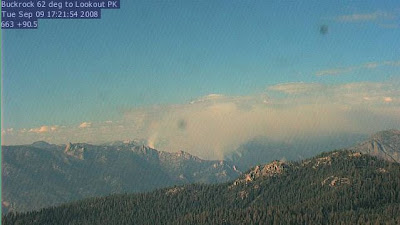
The Tehipite fire in Kings Canyon National Park and the Sierra National Forest has been burning since July 14.  It can now be observed almost live on a web cam.  Here is an example from Tuesday afternoon.

From InciWeb:
The Tehipite Fire has grown to 4,337 acres as of Monday afternoon. Of that acreage, 2,353 acres are within Kings Canyon National Park and 1,984 acres are within the Sierra National Forest. The park and the forest are working together to manage the fire.

In the last several days, the fire has shown increased activity and growth including within the Scepter and Crown Creek drainages on the Sierra National Forest and northwest of Tehipite Valley and north to Kettle Dome in Kings Canyon National Park.

Hayman fire trial: burned letter did not start the fire

Terry Barton, 2002 file photo

From TheDenverChannel:
DENVER -- The lead U.S. Forest Service investigator into the cause of Colorado's largest wildfire testified Tuesday that she doesn't believe a burning letter sparked the fire.

Agent Kimberly Jones was testifying in a Denver federal civil case where five insurance companies and several property owners are suing the federal government for more than $7 million because a USFS employee was convicted of starting the 2002 Hayman wildfire.

When Jones testified that she didn't believe there ever was a letter burned by Terry Barton, the judge interrupted the questioning to ask Jones if she had testified to that previously. She told the judge she was never asked that question on the stand before.

Jones was then asked if that meant that in her opinion that Barton lied when she stipulated that everything in her plea bargain was fact and Jones replied, "Yes."

The plaintiffs are arguing that Barton burned a letter in a campfire ring to make the case that Forest Service is responsible for the 138,000-acre fire that ultimately destroyed 133 homes and outbuildings over three weeks in June 2002.

Plaintiffs are arguing there is a letter to make the case and so the Forest Service is responsible.

Barton was a Forest Service worker who was charged with enforcing the fire ban when she said she burned a two-page letter in a fire ring near Lake George, Colo., and it spread in the dry tinder, sparking the wildfire. The next day, the fire ran 17 miles due to extremely dry conditions.

She did not admit starting the fire until after her arrest. She was convicted and spent nearly six years in a federal prison.
HERE is a link to other articles on Wildfire Today about Terry Barton.


Prescribed fires help control cedar invasion in Nebraska

Left unchecked, cedar trees will invade land in the prairie states and decrease its grazing potential.  The state's Natural Resources Conservation Service helps landowners manage this problem.  Here is an excerpt from an article in the North Platte Bulletin:
.....The trees are sheared off at the base, and then stacked in large piles. To help keep the trees from becoming a problem again, NRCS designs a grazing management plan and recommends landowners conduct a prescribed burn every three to five years after the initial tree cutting has occurred. A prescribed maintenance burn will be required periodically thereafter to maintain the grassland ecosystem.

According to Nichols, fire is one of the most effective methods in controlling cedar trees. But since fire has been removed from the landscape out of fear of causing property damage, the cedar problem has exploded. NRCS, as well as other private organizations like Quail Forever and the Loess Canyons Rangeland Alliance, is working with landowners to help increase the use of prescribed burns.

“A prescribed burn is a highly controlled fire. It isn’t anything like a wildfire. It’s only conducted under very specific conditions after a lot of planning. Once a landowner experiences a prescribed burn and understands how controlled it is, the practice becomes much less intimidating,” Nichols said.

Historically, prairies evolved with disturbances like grazing from bison and antelope, and from wildfires. These disturbances worked together to help keep the prairie system healthy. The hoof action of the grazing animals trampled dead organic matter into the soil. Their grazing helped stimulate new plant growth, and fire helped control excessive woody vegetation.

Monday, September 8, 2008

Wildfire news, September 8

Thursday is seven years after 9/11

President Bush issues a proclamation each year designating 9/11 as Patriot Day. Seven years ago nearly 3,000 people died in the attacks, including 411 emergency responders. The New York City fire department lost 341 firefighters and 2 paramedics.

Some fire departments and other organizations will conduct commemorations of those losses Thursday at the exact time the Trade Center towers collapsed. The south tower fell at 9:58 a.m. ET and the north tower at 10:28 a.m. ET.

Idaho: South Barker fire

This Fire Use fire near Featherville, Idaho has been burning since August 7. If you were going to walk the perimeter, you would need to prepare for a 71-mile hike. The Idaho Statesman has a long article about the fire; here is a brief excerpt.
There is more than 34,000 acres of land inside the boundary of the fire. But wildlife biologist David Skinner estimates that only about half of that, possibly even less, has actually burned.

The fire is burning a "mosaic" pattern, he said - low-intensity fires often leave lots of land untouched, and the more fires are allowed to burn through forests, the
more likely the fires are to remain low-intensity.

A walk through the burned portion of the fire reveals blackened hillsides with healthy, green trees. In some places, burned land abuts lush drainages. This kind of fire doesn't often produce the heat necessary to kill large trees. Thick bark on Ponderosa pine trees makes them more resilient to fire.

In his meetings with area residents, Wehrli repeatedly assures people that the fire isn't turning their recreation areas into a "moonscape."

"Firefighting is changing and you're going to see a lot more of these kinds of fires, an
d less suppression," Norman said. "And that's not a bad thing."
"Fire is a reset button"

From the Calgary Herald:
The Alberta government is setting ablaze 12 times as much land in southern Alberta as it did just four years ago, in a bid to fight mountain pine beetles and eliminate the fuel for wildfires that threaten communities.

"Fire is a re-set button," said Rick Arthur, a government wildfire prevention officer. "If we don't do something, then we're putting the ecosystem at risk."

And speaking of pine beetles...

A saw mill in Colorado has converted to a pellet plant, now running 24/7 processing beetle-killed trees into fuel for heating homes and schools, according to cbs4denver.com:
KREMMLING, Colo. (CBS4) ― As many as a dozen semi-trucks loaded with logs roll into the Confluence Energy pellet plant in Kremmling on a daily basis. Piles of logs are stacked all around a white, metal building where the dead trees are processed.

About 30,000 tons are waiting to be turned into pellets; the plant puts out about 200 tons a day. The entire business is aimed at recycling Colorado's dying forests.

About 1.5 million acres of lodgepole pines in Colorado are dead or dying from pine beetles, which infect the trees with a fatal fungus after they burrow into to them to lay eggs.

"The reason it [the plant] started is there was no one really doing anything about it, there was a lot of happy talk talk that this needs to be done and that needs to be done but it didn't seem like anyone was jumping into the deep end of the pool," said business owner Mark Mathis. "We can offset a tremendous amount of natural gas and fossil fuel by utilizing wood pellets. Basically this plant alone can heat 40,000 homes."

Insurance companies sue USFS over Hayman fire

Five insurance companies have filed a lawsuit against the U.S. Forest Service over the 2002 Hayman fire southwest of Denver. From the Rocky Mountain News:
Five insurance companies that paid claims stemming from the 2002 Hayman Fire
say the federal government should repay them because its crews - including the woman who started the blaze - didn't put out the fire quickly enough.

In a case scheduled to go to trial today in federal court in Denver, t
he companies will try to recoup the approximately $7 million paid to area property owners.

Terry Barton, file photo

Among the witnesses who could take the stand later this week is Terry Barton, the U.S. Forest Service employee convicted of sparking the 137,000-acre fire by burning a letter from her estranged husband.

Barton was released from federal prison in June after having served five years and two months of a six-year sentence.

State Farm Fire & Casualty, Hartford Underwriters Insurance, Property and Casualty Insurance Co. of Hartford, Hartford Fire Insurance Co. and Allstate Insurance filed suit in 2006.

They argue that the Forest Service was negligent because it allowed Barton to work alone the day she started the fire, didn't properly train her to contain the fire once it started and took too long to dispatch firefighters.

They also say Barton, while working in an official capacity, drove away from the fire before she was certain it had been extinguished. When she returned later, the fire had spread out of control.

Attorneys for the government say Barton wasn't acting within the scope of her employment when she started the fire, so under federal law the Forest Service is immune from a negligence claim.

"Burning the letter from her estranged husband was purely personal and was not done to further the Forest Service's interests," Assistant U.S. Attorney William Pharo wrote in a court filing.

Pharo also disputes the allegation that the fire response was inappropriate. He said there could be "enormous" consequences - such as no one volunteering to fight fires - in putting the burden of compensation on the responders.

"Public and social interests require that individuals will be willing to put their lives at risk to fight wildfires, and that they have the discretion to balance multiple factors in determining how best to fight the fires," he stated.

Barton was ordered to reimburse the Forest Service about $14.6 million. She also could be ordered to pay the state up to $27.5 million more, though prosecutors acknowledge she will likely be able to pay only a very small portion of her debt.
California: Private aerial fire patrols

It is news to us, but according to the Eureka Times-Standard certain owners of timber lands are required by the federal government to conduct regular fire patrols.

Monday, July 21, 2008

Wildfire news, July 21

Oxyoke Fire southwest of Denver forces evacuations

A fire near Decker, Colorado caused evacuations of nearby campgrounds and about a dozen homes on Sunday. Five airtankers and two helicopters were working the 105-acre fire which is northeast of the 2002 Hayman blaze, the largest wildfire in the state's recorded history. That fire burned 138,000 acres and destroyed 133 homes. As of last night the fire was 0% contained. Here is a link to a map, and more information is HERE.

UPDATE @ 1820 MT
As of mid-morning today the fire was 140 acres and 0% contained.


An air tanker drops retardant Sunday on the Oxyoke fire north of Deckers. ( Helen H. Richardson, The Denver Post)

Greek and South African firefighters in the U.S.

In addition to the 45 firefighters from Australia and New Zealand helping out with the fires in California, there are four from Greece and two from South Africa in the country. The Greeks are working on the Little Tujunga Hotshots, a crew that has been reconstituted after a 28-year absence. From the USFS web site:
This is the first year of the two-year program for the Greek firefighters from the Hellenic Fire Brigade. This training opportunity was specifically designed to develop hand crews for Greece which had devastating wildfires about a year ago and has similar climate and fuel types with Southern California.

In this photo of the Little Tujunga Hot Hotshots, the Greek firefighters are in blue. Click HERE for a large version of the photo.

The two from South Africa (SA) are senior instructors and crew leaders assigned to the Missoula based Great northern Fire Crew through the middle of September. If fire activity in the Northern Rockies increases, others from SA will be brought over. According to Tim Murphy:
1) 2ea. South African Regional Fire Managers (FMOs) who will shadow state DNRC FMOs in air and ground fire operations

2) Command and General staff personnel from a South African Incident Management Team will shadow our Northern Rockies IMTs to help them continue to implement the Incident Command System in Southern Africa.

3) We also hope to get the Chairman of the Board from the SA Fire Program to look at all risk ICS. He just retired as the SA National Director of Disaster Management.
(Thanks to Chuck for the tip.)

Burn outs continue on the Basin fire east of Big Sur, California

Firefighters are making great progress on the east side, where the only remaining open line is in the Arroyo Seco area, but there is still a lot of work left to do on the north side, east of Big Pines, and in the Los Padres dam area. The fire is 137,260 acres and is 70% contained. From the Monday morning update:
Yesterday afternoon burnout operations were very successful along containment lines on the east side of the fire from Piney Creek south towards Arroyo Seco, and along Chews Ridge.

Burnout operations along Chews ridge will resume this afternoon after the morning's moist marine weather conditions lift. Burnout of small islands and draws in other east side locations will occur where needed.

Yesterday, burnout operations to reinforce containment lines on the north side of the fire along Blue Rock Ridge and Hennickson's Ridge were postponed due to wind direction. National Guard C-130 airtankers dropped retardant just outside these containment lines in preparation for later burnout operations. Airtankers with retardant will continue preparation work today, and burnout operations along these containment lines will begin with favorable wind and humidity.

Monday, June 2, 2008

Terry Barton released from prison

Terry Barton, convicted of starting the 138,000 acre Hayman fire in 2003, was released from prison this morning. She started the fire while she worked as a Fire Prevention Technician on the Pike National Forest in Colorado.

The fire burned 133 homes and forced 8,000 people to evacuate, including the judge who presided over one of the proceedings related to the case. She served six years in a federal prison in Fort Worth, Texas.

Wildfire Today covered other aspects of this story HERE.

The picture is from 2002 when she appeared in court, courtesy of the Denver Post.

Friday, April 4, 2008

Opinions about Terry Barton, Hayman fire arsonist

In other posts, here and here, we covered the Terry Barton situation. She is the US Forest Service Fire Prevention Technician who started the 138,000 Hayman fire in Colorado in 2002. On March 27 her 12-year state sentence was thrown out by an Appeals court, leaving her with a 6-year federal sentence.

The father of one of the firefighters that died in a vehicle accident while driving to the Hayman fire wrote a letter to the editor of the Denver Post expressing his opinion that a 6-year sentence is not adequate.

An article in the Colorado Springs Gazette has a similar view.

Thursday, March 27, 2008

Terry Barton re-sentenced today for starting Hayman Fire

Terry Barton was a Fire Prevention Technician for the US Forest Service when she started what became the 137,000-acre Hayman fire on the Pike National Forest in 2002.

Unless there are further legal proceedings, it appears that she will be out of prison in June.

From the Colorado Springs Gazette:
"Terry Barton, who set the worst fire in Colorado history, was re-sentenced to 15 years probation and 1,500 hours of community service today by 4th Judicial District Judge Thomas Kennedy.

Her first sentence on a state arson charge - 12 years in prison - was tossed out by the Colorado Court of Appeals in 2004 because of issues with the way the original judge handled her case.

Barton is in a prison in Texas, serving out the remainder of a six-year sentence on federal charges for starting the Hayman fire. She's scheduled to be released from prison in June, according to her attorney.

Once she's released, she'll have to check in with 4th Judicial District probation officials. Her new sentence on the state charge will be retroactive to 2003, meaning she'll be on the hook for community service hours and probation check-ins until 2018.

In June 2002, Barton - a U.S. Forest Service employee - reported that a fire started in a campground northwest of Lake George. About a week later, she was arrested after admitting she accidentally started the fire by burning a letter from her estranged husband.

The fire burned 137,000 acres in the Pike National Forest and destroyed 133 homes."

Earlier we covered other developments in this case.

UPDATE: March 28

In yesterdays' court proceedings, district judge Thomas Kennedy ordered Barton to pay restitution — estimated to be at least $30 million — on top of the $14.6 million in restitution that is part of her six-year federal sentence.

More from the Denver Post today:

Barton, who began serving her federal sentence in 2003, is due to be released in June from prison in Texas. She must report to the El Paso County probation office within a week after leaving federal custody.

Barton's 12-year state prison sentence was overturned in 2004 by the Colorado Court of Appeals.

The appeals court found the judge failed to disclose that the Hayman fire forced him to evacuate and that he doubled the presumptive range of her sentence inappropriately because only a jury could find aggravating factors.

Prosecutors then argued that Barton's appeal of her sentence violated the terms of the plea agreement, which allowed them to withdraw it.

In January, the Colorado Supreme Court ruled they could not withdraw from the agreement.

It said Barton would face only one count in one county, would serve any state sentence concurrently with the federal sentence, and she could not appeal any state sentence.

Newsome said the amount of restitution must be determined within 90 days, saying, "It will be at least $30 million."

While the DAs understand the amount may never be paid, Newsome said state law requires a judge to impose restitution for actual losses and ensures victims' right to pursue civil judgments.

Tuesday, January 15, 2008

USFS Employee Convicted of Starting Fire May Be Released From Prison Early


In 2003, Terry Barton, a U.S. Forest Service Fire Prevention Technician, was convicted of starting the 2002 Hayman fire on the front range of Colorado. She was sentenced to 12 years in prison by the state and 6 years by a federal court. In an appeal, the 12 year sentence was thrown out. Since she has already served 5 years, she could be released in a year. But it's not over yet. There is another hearing scheduled for February 11 when there could be another change related to the state sentence. Barton's attorneys are arguing that the state judge's sentencing decision, double the standard sentence, was affected by the fact that he voluntarily evacuated during the fire.

The Hayman fire burned 138,000 acres and 133 homes; 8,000 people were evacuated. Aside from prison, Barton also was ordered to pay $42.2 million in state and federal restitution.